If you run marketing for a large Indian business, the right agency is the one that can handle your scale, your stakeholders and your compliance requirements, not the one with the lowest quote. A wrong choice costs more than the retainer: it can mean lost quarters, duplicated work across teams and campaigns that cannot be audited.
This guide gives you a 12-point checklist for evaluating an enterprise digital marketing agency in India, the questions to ask in your first meeting, and the mistakes procurement and marketing teams most often make. Use it to build your shortlist, score each vendor and defend your decision internally.
Digital Hive has worked with large organisations since 2003, so this checklist reflects what we see from both sides of the table.
Why choosing an enterprise agency is different from choosing for a small business
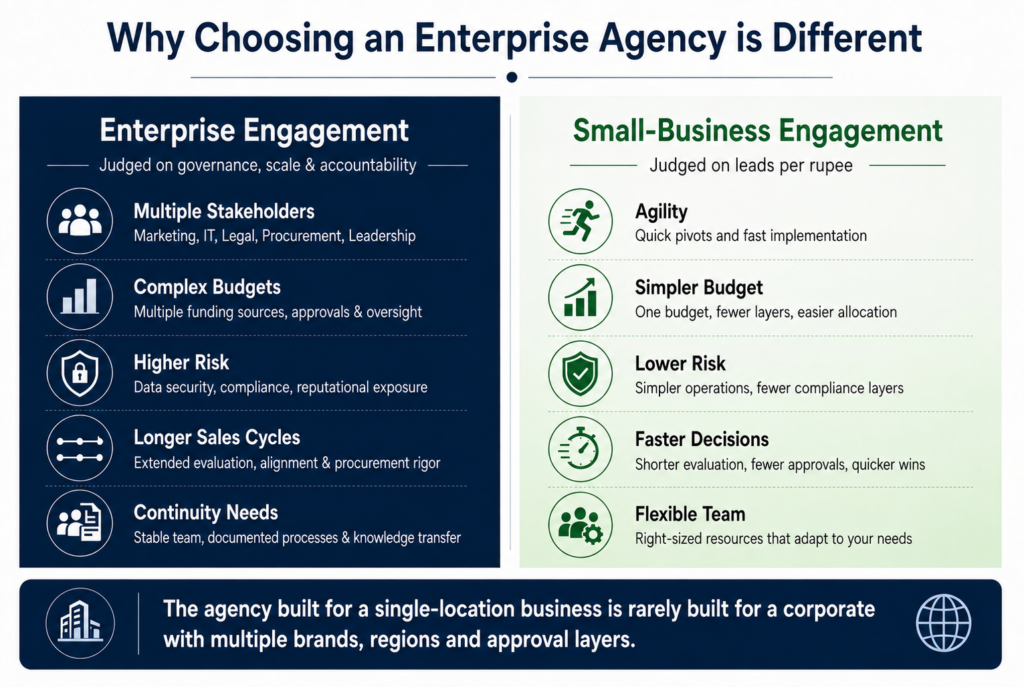
An enterprise engagement is judged on governance, scale and accountability, while a small-business engagement is usually judged on leads per rupee. The agency that suits a single-location business is rarely built for a corporate with multiple brands, regions and approval layers.
The differences show up quickly:
- More stakeholders. Marketing, IT, legal, procurement and the leadership team all have a say, so the agency must manage approvals without stalling delivery.
- Larger and more complex budgets. Spend is spread across channels, business units and markets, and finance expects clear attribution.
- Higher risk. Brand reputation, customer data and regulatory exposure are all on the line, which makes security and process maturity non-negotiable.
- Longer sales cycles. Enterprise buyers research for weeks or months, so the agency must support the full journey, not just the last click.
- Continuity needs. You need a team that stays stable for years, with documented processes, not one that depends on a single account manager.
Keep these differences in mind as you work through the checklist below.
The 12-point checklist for choosing an enterprise digital marketing agency
Score each shortlisted agency from 1 to 5 on every point below. Weight the points by what matters most to your business, for example data security for BFSI or healthcare, and scalability for multi-brand groups.
1. In-house team vs outsourced team
Ask who will actually work on your account when choosing an SEO Company in Gurgaon. Some agencies pitch with senior people and then hand delivery to freelancers or third-party vendors. Look for an agency whose strategists, SEO specialists, designers, developers, and media buyers are full-time employees, with named leads for your account. A genuinely in-house team gives you faster turnaround, tighter quality control, and clearer accountability.
This is how Digital Hive works: senior people stay on your account, and nothing is outsourced to third-party vendors. This approach ensures better communication, consistent quality, and a reliable SEO strategy focused on your business goals.
2. Industry experience
Enterprise marketing depends on context: buyer behaviour in manufacturing differs from real estate, education or financial services. Ask for experience in your sector or a close one, and for examples of how the agency handled sector-specific challenges such as long B2B cycles, regulated claims or dealer networks. Experience with large businesses matters more than a long list of small clients.
3. Integrated SEO + web + ads capability
Enterprise growth rarely comes from one channel. SEO, website development, paid search, paid social and content need to work from one plan, one set of data and one team. When these sit with separate vendors, you get conflicting priorities, slower decisions and gaps in the customer journey. Check that the agency can do all of it well, and that the channels share keyword, audience and conversion insights.
4. Reporting quality
Good reporting ties activity to business outcomes the agency can influence: qualified leads, cost per lead or acquisition, conversion rates and lead sources, not just impressions and rankings. Where your CRM is connected, it should also show which channels feed your pipeline, even though closing the sale is your team’s job. Ask to see a sample dashboard and a sample monthly report. Look for custom dashboards your leadership can read without a briefing, clear explanations of what changed and why, and the next actions. Confirm the cadence: weekly updates, monthly reviews and quarterly strategy sessions are typical for enterprise accounts.
5. Data security
Your agency will touch analytics, CRM data, ad accounts and customer information. Ask how access is controlled, whether the team uses role-based permissions, how credentials are stored and what happens when an employee leaves. Ask about their obligations under India’s Digital Personal Data Protection Act, 2023, and whether they will sign an NDA and a data processing agreement. Your IT or security team should be part of this conversation.
6. Scalability
Can the agency grow with you? Test this by asking how they would handle a launch in five new cities, a tenfold increase in content volume or a sudden jump in ad spend. Look at their team depth, their processes and their tooling. An agency that depends on a few key people will struggle when your needs expand.
7. Account management
An enterprise account needs a dedicated point of contact with enough seniority to make decisions and to challenge you when needed. Ask who the account lead will be, how many accounts they manage, how escalations work and what the backup is if they are unavailable. Good account management keeps multiple departments aligned and keeps projects moving.
At Digital Hive, every project has an account manager, and every enquiry gets a human reply.
8. Technology stack
Ask which analytics, SEO, marketing automation, CRM and reporting tools the agency uses, and whether they can work with the tools you already have. Check experience with enterprise platforms, tag management, server-side tracking and integration with your CRM. Also confirm who owns the tools and data: your accounts, dashboards and tracking setup should belong to you, not the agency.
9. Case studies and references
Ask for case studies that show the problem, the approach and measurable results, ideally for businesses of your size. Then speak to references directly. Ask the referees what went well, what went wrong and how the agency responded. Be cautious of case studies that report vague gains without baselines or timeframes.
10. Contract and SLAs
Read the contract as carefully as the proposal. Look for a clear scope of work, deliverables, timelines, response times, reporting schedule, notice period and exit terms. Make sure ownership of creative assets, websites, ad accounts and data is stated plainly. Service-level agreements should say what happens when targets are missed, and how performance will be reviewed.
11. Client retention
How long does the agency keep its clients? Long relationships usually signal consistent results and a stable team. Ask for the average client tenure and the retention rate of enterprise accounts, and ask why clients have left. An honest answer here tells you a lot about how the agency handles difficulty.
Digital Hive reports a 95% client retention rate, and some of our SEO engagements have run for more than 15 years.
12. Pricing transparency
Enterprise pricing should be clear and predictable. Ask for a breakdown of retainers, project fees, media management fees and tool costs, and find out what is included and what is billed extra. Be wary of unusually low quotes, hidden charges and pricing that is not linked to the scope of work. The best value is rarely the cheapest option: it is the agency whose fees match the effort, expertise and outcomes you need.
Questions to ask in the first meeting
The first meeting should test depth, not polish. These questions quickly separate agencies that can manage enterprise work from those that only present well.
- Who will be on my account day to day, and which of them are full-time employees?
- Which clients of our size and sector have you worked with, and what changed for them?
- How do you set goals and KPIs, and which ones will you be accountable for versus our sales team?
- How would you approach SEO, the website and paid media together in the first 90 days?
- What does your reporting look like, and can we see a sample dashboard?
- How do you protect our data, ad accounts and credentials?
- How do you handle approvals when several departments are involved?
- What happens if results fall short of the plan in the first six months?
- Who owns the accounts, creative assets, tracking setup and data at the end of the contract?
- How is pricing structured, and what costs are not included?
Pay attention to how specific the answers are. Clear, evidence-backed answers point to a mature agency, while general promises suggest the opposite.
Common mistakes when selecting an agency
Most failed agency relationships can be traced back to the selection stage. Avoid these mistakes:
- Choosing on price alone. The lowest quote often leaves out strategy, reporting or senior time, and the gap shows up later as rework.
- Being impressed by the pitch team. The people who present are not always the people who deliver. Ask to meet the team that will run your account.
- Skipping reference checks. A case study is a summary written by the agency. A call with a current client tells you what working with them is really like.
- Hiring separate vendors for each channel. This creates silos, duplicated costs and finger-pointing when results dip.
- Overlooking data ownership. If the agency controls your ad accounts, analytics or website, leaving them becomes difficult and expensive.
- Setting vague goals. Without agreed KPIs, baselines and review dates, it is hard to judge performance or hold anyone accountable.
- Ignoring security and compliance. Involve your IT and legal teams before signing, not after an issue appears.
- Skipping a pilot or phased start. A defined first phase lets both sides test the working relationship before a long commitment.
Also read this blog: – Things To Know Before Choosing A Digital Marketing Package
How Digital Hive approaches enterprise accounts
Digital Hive started in 2003 as Sagacious Softwares, and we have spent 23 years and 1,000+ projects learning what large organisations need from an agency. Our enterprise approach is built around the points in this checklist, so you can hold us to them.
- One in-house team, nothing outsourced. Website development and maintenance, SEO, Google Ads and social media are delivered as one integrated service by our own team in Gurgaon, with no handoffs to third-party vendors.
- Experience with large rollouts. In 2007, ExxonMobil commissioned us to build 16 websites for its dealer network across India. Since then we have served 35+ industries, including engineering, manufacturing, healthcare, hospitality and construction.
- A process you can audit. We start with a discovery call and a written plan with deliverables and timelines. Design and build run with regular checkpoints, and every launch includes technical sign-off, SEO checks, redirect mapping and analytics verification.
- Reporting you can read. You get monthly reports and quarterly strategy reviews, and we adjust the plan on data, not assumptions.
- Results over the long term. For a B2B manufacturer we have worked with since 2009, top-10 keywords grew from 2 to 55 and global presence reached from 5 to 35 Countries. A speed-focused website rebuild for another client delivered 5X organic traffic and lead growth, with bounce rate falling from 72% to 38%. See more in our success stories.
- Clients who stay. Our client retention rate is 95%, and we use the same dedicated account structure for every engagement.
- A free SEO audit. We review your search visibility, technical health and competitive gaps at no cost and with no obligation. We also offer a free 30-minute consultation.
Based in Gurgaon, we work with corporate teams across India. If you are building a shortlist, get in touch with Digital Hive and we will walk you through how we would approach your account.
FAQs
An enterprise agency is set up for scale, governance and accountability. It works with multiple stakeholders, handles larger budgets across channels and markets, follows stricter security and reporting standards, and provides a dedicated team and senior account management.
Most large businesses take four to eight weeks, covering shortlisting, meetings, proposals, reference checks and contract review. Involving procurement, IT and legal early avoids delays.
It should cover scope of work, deliverables, KPIs, reporting schedule, service levels, pricing and billing terms, confidentiality, data protection, ownership of assets and accounts, and clear notice and exit terms.
For most enterprises, one integrated agency is easier to manage and performs better, because channels share data and strategy. Separate specialists can make sense for very niche needs, but they require strong internal coordination.
Split your KPIs into what the agency controls, what it shares with your team, and what only your team controls, and hold the agency accountable only for the first two.
- The agency controls: organic rankings and visibility, traffic, website speed and technical health, ad performance (click-through rate, cost per click), landing-page conversion rate, and the number and cost of leads or enquiries.
- Shared with your team: lead quality. The agency is responsible for attracting the right audience and tightening targeting, while your team gives feedback on which leads were relevant so both sides can refine it.
- Your team controls: follow-up speed, sales conversion, deal size and closed revenue. These depend on your sales process, pricing and market, so an agency cannot fairly be measured on them.
Still, track revenue and pipeline so the agency can see which channels and keywords bring in business that actually closes. This needs a simple feedback loop: connect your CRM to analytics, tag lead sources, and review lead quality together every month. Set baselines before the work begins, review results in monthly reports and quarterly strategy sessions, and adjust the plan as the data comes in.