For nearly two decades, backlinks were the single most debated currency in SEO. Build enough of them — from authoritative sites, in the right niches — and rankings would follow. Entire agencies built their business models on link acquisition. Entire industries of link farms, guest post networks, and private blog networks (PBNs) emerged to game the signal.
That era is not over. But it is changing faster than most SEO practitioners are willing to admit.
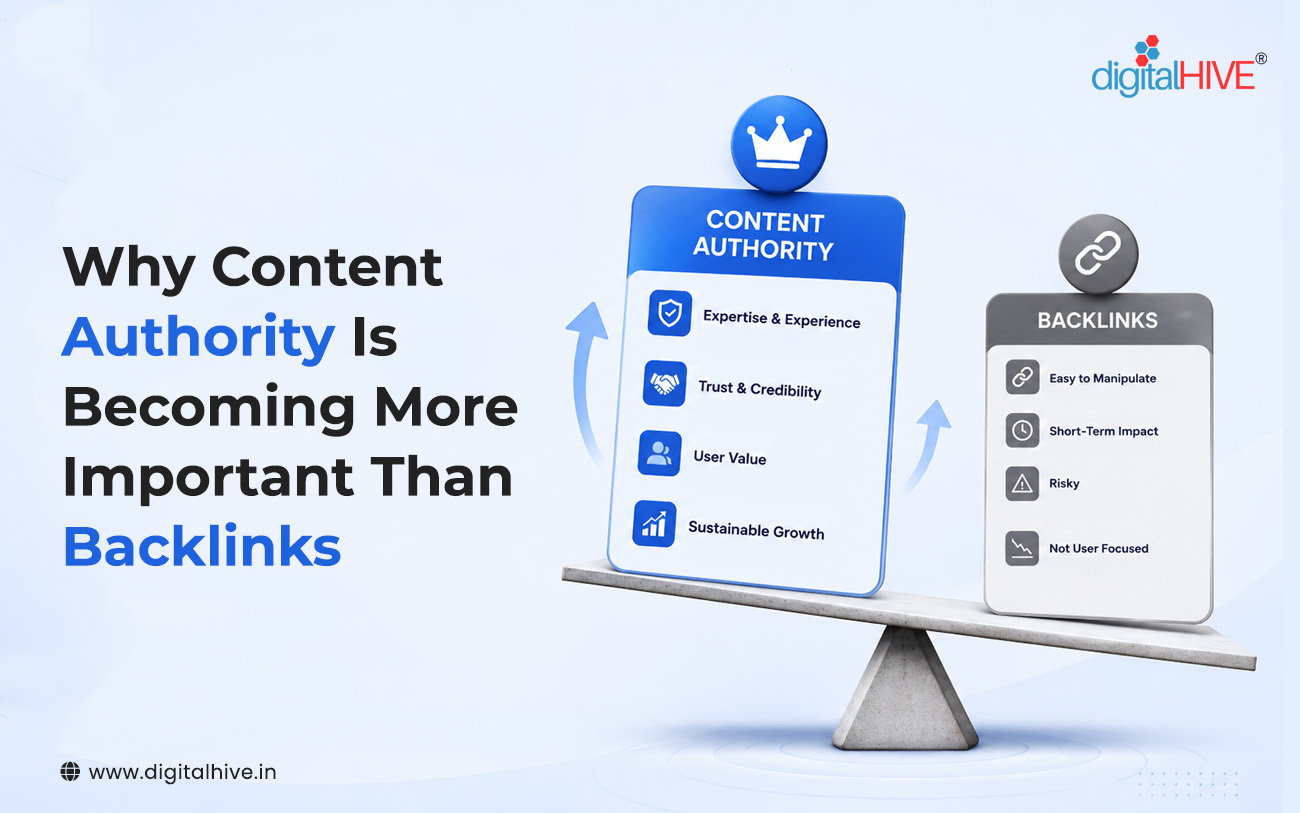
Google’s understanding of content has evolved from keyword matching to semantic comprehension to, now, a genuine attempt to evaluate the expertise, authority, and trustworthiness behind every page it indexes. In that environment, content authority — the demonstrable depth, consistency, and credibility of what you publish — is quietly becoming a more durable ranking asset than the number of links pointing at your domain.
This is not a post telling you backlinks are dead. They are not. But the balance is shifting, and if your SEO strategy is still primarily a link-acquisition operation, you are already behind.
| Metric | Value | Context |
|---|---|---|
| AI Overview prevalence | 47% | Share of Google searches showing AI Overviews (US, 2025) |
| CTR impact | ~34% drop | Average click-through rate decline below an AI Overview result |
| Algorithm volatility | ~3,200 | Algorithm updates Google made in 2023 alone |
| Quality framework | E-E-A-T | Google’s four-pillar quality framework, in place since 2022 |
The Backlink Era: What It Was, Why It Worked, and Why It Started Cracking
Backlinks worked — and still work — because they were Google’s proxy for real-world editorial endorsement. When a respected site linked to yours, it was assumed to be a vote of confidence. The logic was borrowed from academic citation: a paper cited by many other papers was likely more significant than one cited by none.
The problem was always that this signal was gameable. And so it was gamed — relentlessly.
Over time, Google’s response to link manipulation became more sophisticated: Penguin in 2012, manual penalties for link schemes, the gradual devaluation of low-quality links, and the evolution of link evaluation from domain authority to contextual relevance to topical alignment. Each iteration made raw link counts less valuable and link quality more important.
But the more fundamental shift came with BERT (2019), MUM (2021), and the AI-powered core updates that followed. Google stopped just understanding words and started understanding meaning, intent, expertise, and context. In that environment, a well-constructed page from a genuine subject-matter expert started outperforming a thin page with a thousand mediocre backlinks.
| 📌 The Tipping Point Google’s introduction of the E-E-A-T framework (Experience, Expertise, Authoritativeness, Trustworthiness) in its Search Quality Evaluator Guidelines marked the formal acknowledgement that content quality signals are evaluated independently of link signals. For YMYL (Your Money or Your Life) topics — health, finance, legal, safety — E-E-A-T is now a hard filter that links alone cannot override. |
What Content Authority Actually Means (and What It Is Not)
Content authority is a term used loosely, so it is worth being precise about what it means in practice.
Content authority is not just “good writing.” It is not having a blog with many posts. It is not keyword-rich content. Those things can be components of it, but they are not the thing itself.
Content authority is the state where a website, and the people behind it, are recognised — by Google, by users, and by the broader web ecosystem — as a reliable, expert source within a defined topic domain. It has several measurable characteristics:
| Signal | What It Looks Like in Practice |
| Topical Depth | The site covers a subject area comprehensively — not just top-level posts but supporting content, FAQs, edge cases, and nuanced sub-topics that demonstrate thorough knowledge |
| Author Credibility | Content is attributed to real people with verifiable expertise. Author bios link to professional profiles; authors are cited or quoted in third-party publications |
| Content Freshness & Accuracy | Existing content is regularly audited, updated, and corrected. Outdated information is removed or flagged. Data sources are cited and current |
| On-Site User Signals | Visitors engage meaningfully: low bounce rates on key pages, time-on-page consistent with content depth, low pogo-sticking back to SERPs |
| Topical Cluster Structure | Content is organised around pillar pages and topic clusters, not isolated posts, showing a deliberate architecture of knowledge rather than random publishing |
| First-Hand Experience | Content reflects genuine experience with the subject: original case studies, real data, practitioner perspectives — not assembled summaries of what others have written |
| AI Citation Probability | In the era of AI Overviews and LLM-driven search, authoritative content is more likely to be cited as a source in AI-generated answers — a new and growing visibility channel |
The Old Way vs The New Way: A Direct Comparison
Understanding the shift in practical terms helps prioritise what to build. Here is how the same SEO goals are approached under old-model and content-authority-model thinking:
| Old SEO Thinking | Content Authority Thinking |
| Get more backlinks to rank higher | Build topical authority so rankings are earned and maintained without continuous link acquisition |
| Write content to target a keyword | Build content that comprehensively serves the searcher’s intent around a topic cluster |
| Publish as many posts as possible | Publish fewer, deeper, better-researched pieces and audit existing content for quality |
| Domain Authority (DA) as the key metric | Topical authority, organic CTR, and content engagement as the primary metrics |
| Guest posting primarily for link acquisition | Guest posting to establish author credibility and reach new audiences, with links as a secondary benefit |
| Outsource content to low-cost writers | Involve subject matter experts (in-house or verified freelancers) in content creation at every stage |
| Rank for a keyword | Be the recognised source on a topic, so rankings persist across algorithm updates |
The distinction is not philosophical. It produces materially different outcomes in traffic stability, conversion rates, and resilience to algorithm updates. Sites built on genuine content authority consistently recover from core updates; sites built primarily on link manipulation consistently decline.
The AI Search Shift: Why Content Authority Matters More Now Than Ever
The emergence of AI Overviews in Google Search has introduced a dynamic that makes content authority not just a ranking advantage but a prerequisite for visibility.
When Google’s AI constructs an overview response to a query, it does not cite pages because they have the most backlinks. It cites pages because their content is clear, accurate, credibly sourced, and well-structured. In other words, it prioritises exactly the properties that define content authority.
This creates a new and significant split in search real estate:
| Search Result Type | Who Gets Cited | What Drives Citation |
| AI Overview / AI Mode | High-authority content sources | Depth, accuracy, clear structure, author credibility, original data |
| Traditional Organic #1–10 | Well-optimised pages with strong signals | Mix of content quality, links, technical SEO, and UX |
| Featured Snippets | Directly answer-formatted content | Precise, structured answers within authoritative pages |
| People Also Ask | Topically comprehensive sites | Coverage breadth and relevance within a topic cluster |
| GEO (Generative Engine Optimisation) | Cited in AI chatbot answers (ChatGPT, Perplexity, Gemini) | Brand mentions, authoritative publishing, structured data, original research |
The implication is that a site which invests in content authority is optimising for multiple visibility channels simultaneously — traditional organic, AI Overviews, featured snippets, and generative AI citation. A site optimising primarily for backlinks is investing in a signal that has diminishing relevance to the fastest-growing search surfaces.
| ⚡ The GEO OpportunityGenerative Engine Optimisation — the practice of optimising content to appear as a cited source in AI-generated answers — is almost entirely driven by content authority signals: original research, clear expertise markers, factual accuracy, and structured content. Backlinks play a secondary role. For brands that invest in authoritative content now, GEO visibility will compound over the next 2–3 years. |
How Google Actually Evaluates Content Authority in 2025–2026
Google does not have a single “content authority score” as a ranking factor. What it has is an interconnected set of signals that, collectively, approximate quality, expertise, and trust. Understanding these signals is what translates content authority from a concept into an executable strategy.
E-E-A-T: The Framework Behind the Evaluation
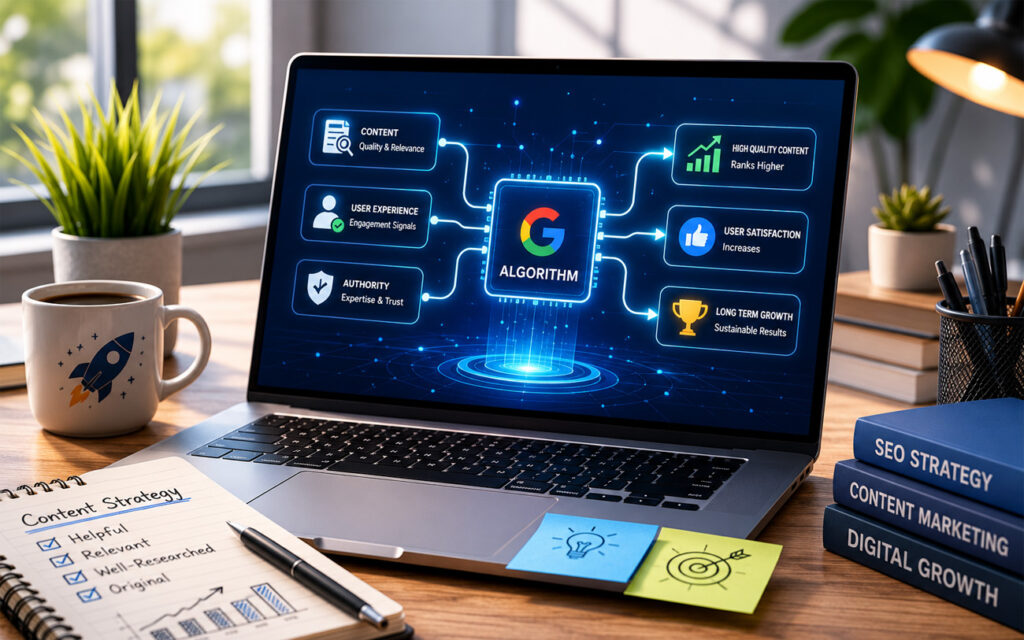
E-E-A-T stands for Experience, Expertise, Authoritativeness, and Trustworthiness. Introduced formally in Google’s Quality Evaluator Guidelines, it is the lens through which Google’s quality raters (and increasingly its algorithms) assess whether a page’s content deserves to rank.
- Experience: Has the author or site demonstrably used, practised, or been involved in the subject? First-hand experience content — real case studies, original data, practitioner perspectives — outperforms assembled summaries.
- Expertise: Does the content reflect genuine knowledge depth? This goes beyond surface-level accuracy to include nuance, edge cases, and the kind of insight that only comes from working within a field.
- Authoritativeness: Is the site, and the people behind it, recognised as a credible source by others in the space? This is where links remain relevant — but specifically links from topically aligned, credible sources, not volume links from unrelated domains.
- Trustworthiness: Can the user trust the information? Transparent authorship, accurate citations, clear policies, and a site that behaves professionally all contribute to this signal.
Topical Authority: Depth Over Breadth
One of the most practically important shifts in modern SEO is the move from domain authority (how authoritative is this website in general?) to topical authority (how authoritative is this website on this specific subject?).
A website that has published 200 posts across 30 unrelated subjects has lower topical authority on any individual subject than a site that has published 40 deeply researched, well-structured posts on a single topic area, with strong internal linking between them.
Topical authority is built through:
- Comprehensive pillar content that addresses the broadest version of a topic
- Supporting cluster content that explores every related sub-topic
- Strong internal linking that signals the relationship between content
- Consistent publishing cadence on the same subject area over time
- Content that ranks for the full spectrum of searcher intent — informational, navigational, commercial and transactional
User Signals: The Behavioural Feedback Loop
Google has access to behavioural data at a scale that no individual site analytics can match. When users consistently click your result, stay on your page, and do not immediately return to the SERP to try another result — that pattern is a signal. It tells Google that your content is genuinely satisfying the query.
Content authority produces better user signals because authoritative content is more useful. It answers questions completely, anticipates follow-up questions, and is formatted for readability. The result is a self-reinforcing cycle: better content produces better user signals, which produce better rankings, which produce more traffic, which generates more authority signals.
Does This Mean Backlinks Don’t Matter? The Honest Answer
No. Backlinks still matter. For competitive queries, a page with genuinely authoritative content and strong topical relevance but zero inbound links will still struggle to outrank a similarly authoritative page that also has quality links from credible sources.
What has changed is the nature of the link value equation:
| Link Scenario | Actual SEO Value |
| 100 links from generic directories and irrelevant sites | Low to negligible; may trigger quality filters in competitive niches |
| 5 links from highly topically relevant, genuine editorial sources | High; these function as trust amplifiers for already-authoritative content |
| Guest posts on low-quality sites primarily for link building | Declining; Google’s link spam policies have significantly devalued scaled guest posting |
| Being cited as a source in a major industry publication | High; combines link equity with brand authority and E-E-A-T signals |
| Digital PR that generates natural coverage and links | High and growing; earned media links carry the editorial endorsement signal backlinks were always meant to represent |
| Links earned because your content is the best resource on a topic | Highest sustained value; these attract organically and compound over time |
| 💡 The Strategic ReframeInstead of asking “how do I build more links?” the more productive question in 2025 is: “how do I create content so genuinely useful and authoritative that links, citations, and AI references come to it naturally?” Content authority is not the enemy of link building. It is the foundation that makes link building worthwhile. |
Building Content Authority: A Practical Roadmap
Content authority is not built in a single campaign. It is accumulated through consistent, deliberate decisions over time. Here is how to approach it systematically:
| Step | What It Involves |
| 1. Define Your Topic Domain | Choose the specific subject area where you will build authority. Broader is not better. A Gurgaon-based IT staffing firm that becomes the authoritative resource on Indian IT hiring practices will outperform a firm that publishes generically on “business and HR.” |
| 2. Conduct a Content Audit | Evaluate every existing piece of content. Identify which pages have genuine authority potential, which are thin and should be expanded, and which are cannibalising each other or diluting topical focus. Consolidate and redirect where appropriate. |
| 3. Build a Topic Cluster Architecture | Map your subject area into a pillar-cluster structure. One comprehensive pillar page per major topic; multiple cluster posts covering every relevant sub-topic; strong internal linking connecting them. This architecture signals topical authority to crawlers and organises content for users. |
| 4. Invest in Depth and Originality | Commission content that includes original research, proprietary data, genuine practitioner insight, or first-hand case studies. These are the content types most likely to earn natural links, get cited in AI answers, and survive algorithm updates. |
| 5. Build Author Credibility | Create detailed author profiles. Attribute content to real people with verifiable expertise. Ensure those authors have a visible presence — LinkedIn profiles, industry publications, conference speaking — that reinforces their credibility as a source. |
| 6. Audit for Accuracy and Freshness | Establish a content review cadence. Outdated statistics, broken links, and superseded information actively undermine trust signals. Freshness is both a ranking signal and a credibility signal. |
| 7. Earn Links Through Content Utility | Shift link-building from outreach-led acquisition to utility-led attraction. Create resources that other sites will naturally cite: original data studies, comprehensive guides, free tools, industry reports. These earn links at a quality that purchased or outreached links cannot match. |
| 8. Track Authority Metrics, Not Just Rankings | Measure topical coverage (what percentage of queries in your space do you rank for?), content engagement (time-on-page, scroll depth, return visits), brand search volume growth, and AI citation frequency. These lead rankings; rankings follow authority. |
What This Looks Like for Different Business Types
Content authority strategy is not one-size-fits-all. The tactics that build authority for a B2B manufacturer are different from those that work for a local service provider or an e-commerce brand. Here is how the principle applies across common business contexts:
| Business Type | Content Authority Strategy | Core Authority Assets |
| B2B / Manufacturing | In-depth technical content, product application guides, industry-specific whitepapers, certifications pages with explanation | Technical depth, verifiable expertise, case studies with measurable outcomes |
| Professional Services (Legal, Finance, Consulting) | Authoritative explainers on regulatory topics, commentary on industry developments, original research and surveys | Author credentials, regulatory accuracy, original data, clear disclaimers |
| E-Commerce | Category educational content, product comparison guides, buyer’s guides, user-generated content with editorial oversight | Product knowledge depth, genuine reviews, structured data for product authority |
| Local Services (Healthcare, Home, Education) | Local expertise content, practitioner profiles, community-specific guides, patient/client education resources | Local relevance, practitioner credibility, verified reviews, specific location expertise |
| SaaS / Technology | Thought leadership on industry trends, technical documentation, product use-case content, integration guides | Technical accuracy, developer community trust, original product research, changelog transparency |
| Digital Agencies (like Digital Hive) | SEO case studies with real numbers, content strategy frameworks, transparent process documentation, industry commentary | Demonstrated client results, team expertise profiles, thought leadership content, awards and recognition |
Authority Is the Moat. Links Are Just Part of the Wall.
The brands winning in search over the next five years will not be those with the most backlinks. They will be those that their audiences, Google’s algorithms, and AI systems have come to genuinely recognise as reliable, expert sources.
Backlinks are still part of that picture — but they are increasingly the confirmation of authority rather than the creator of it. A site with deep content authority earns links naturally, gets cited in AI answers, ranks across broad topic clusters, and is far more resilient to algorithm updates than a site whose rankings rest primarily on an acquired link profile.
The shift is not sudden. It has been building since BERT, accelerated with E-E-A-T, and is now compounding with the rise of AI-generated search surfaces. The SEO practices that will still be working in 2028 are the ones rooted in genuinely being useful, genuinely being expert, and genuinely being trustworthy.
That is what content authority means. And that is why it matters now more than it ever has.
FAQs
Content authority means creating reliable, valuable, and expert-level content that users and search engines trust. It helps improve rankings and brand credibility.
Yes, backlinks still matter because they signal trust and authority. However, low-quality backlinks are no longer effective, and content quality now carries greater weight.
Search engines focus more on user intent, content relevance, expertise, and trust. Strong content can perform well even with fewer backlinks if it provides real value.
Businesses can improve content authority by publishing well-researched blogs, using expert insights, updating content regularly, and focusing on user needs.
Digital Hive helps businesses build strong content authority with SEO-focused content strategy, keyword research, content optimization, technical SEO and digital marketing services that improve rankings and organic growth.