A handy website maintenance services checklist makes the job easy. Every business with a website already knows maintenance matters – expired SSL certificates, broken links and outdated plugins aren’t a mystery to anyone reading this. The question that actually stalls most teams isn’t “why does this matter,” it’s “whose job is this, and how would we even know if it’s being done properly?”
That’s the gap this post is for. Not another list of reasons to care – a practical audit you can run in ten minutes, a clear picture of who should own maintenance at a business your size, and real numbers on what it should cost so you’re not overpaying or, worse, underpaying for coverage that isn’t actually happening.
The ownership gap: Why website maintenance falls through the cracks
In most small and mid-sized businesses, website maintenance services do not fail because nobody knew these were important. They fail because they don’t clearly belong to anyone. A few patterns show up again and again:
- The freelancer who built it moved on. The site was launched, invoiced, closed. No one has touched the backend since — including security patches.
- “IT handles it” — except IT is one generalist managing servers, laptops, email and a website, in that order of priority. The website loses every time.
- The agency retainer covers design, not maintenance. Marketing agencies often own the content calendar and ad spend but were never contracted for plugin updates or backups.
- Nobody owns it, so nobody notices until a customer reports a broken checkout page or Google Search Console flags a security issue.
The fix isn’t a longer to-do list, it’s naming an owner. That can be an internal hire, a freelancer on retainer, or an agency AMC (Annual Maintenance Contract) plan. What matters is that one party is accountable, with a defined scope and a way to verify the work is actually happening.
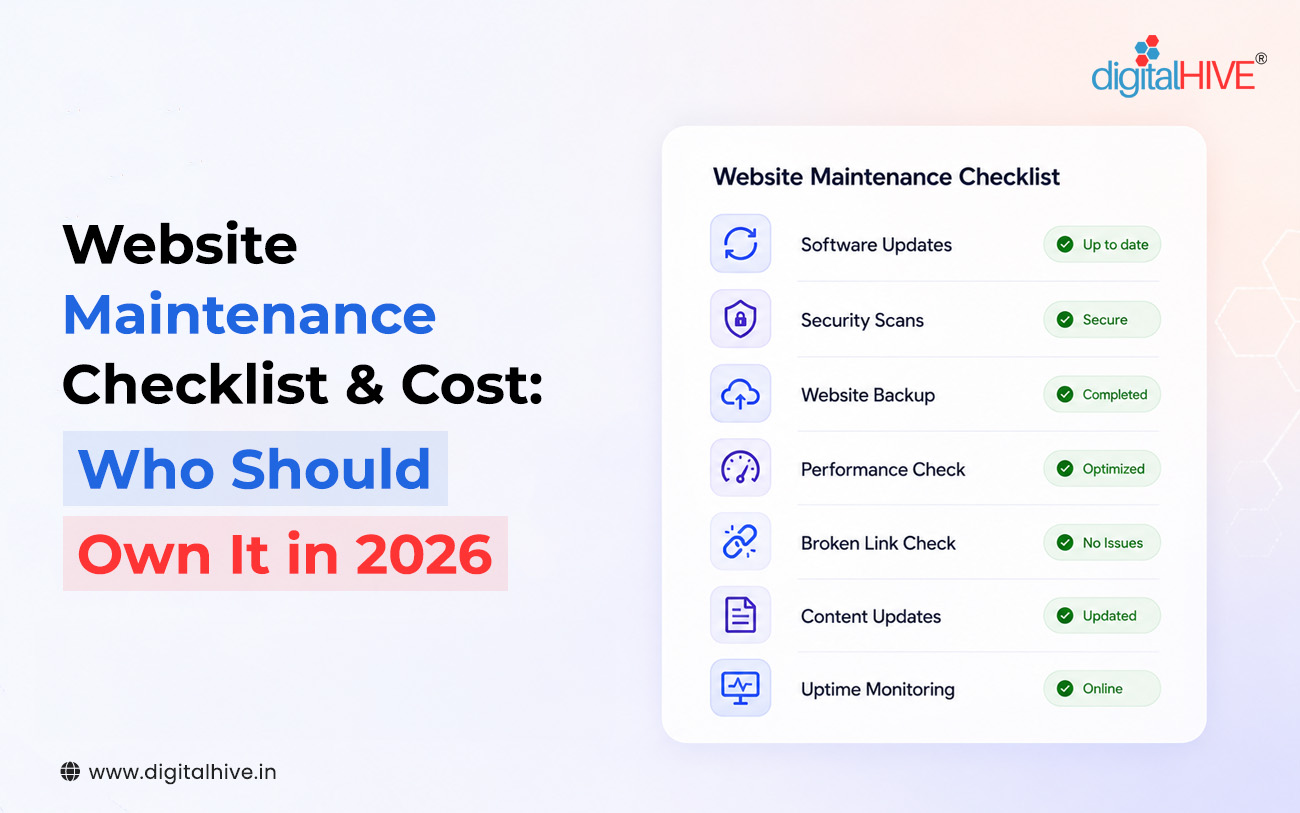
10-Minute Self-Audit with Website Maintenance Checklist
Before you decide who should own maintenance, find out where you currently stand. Go through this list and mark each item honestly – this takes about ten minutes with access to your hosting dashboard, Google Search Console and your CMS admin panel.
| Check | ✓ |
| SSL certificate is valid and not expiring within 30 days | ✓ |
| CMS core, theme and all plugins updated within the last 30 days | ✓ |
| A full backup (files + database) exists from within the last 7 days | ✓ |
| You know exactly where that backup is stored and can access it yourself | ✓ |
| Zero broken links or 404s on primary navigation and top landing pages | ✓ |
| Google Search Console shows no unresolved crawl errors or manual actions | ✓ |
| Site loads in under 3 seconds on mobile (test: PageSpeed Insights) | ✓ |
| Contact forms and checkout/lead flows tested working in the last 30 days | ✓ |
| Content — pricing, offers, team — reflects current reality, not last year’s | ✓ |
| You have a named person or vendor responsible if the site goes down today | ✓ |
| That person/vendor has a defined response-time commitment (SLA) | ✓ |

Scoring:
- 9–11 checked: Your maintenance is in reasonably good shape. Focus on formalising the process so it survives staff or vendor turnover.
- 5–8 checked: You have partial coverage with real gaps. This is the most common and most dangerous score, because it creates a false sense of security.
- 0–4 checked: Maintenance is effectively not happening. Treat this as urgent, not eventually particularly the security and backup items.
What Website Maintenance Services Actually Cost?
Pricing for website maintenance services varies widely because the term covers very different scopes of work. Here’s a realistic breakdown for the Indian SME market:
| Approach | Typical Monthly Cost (INR) | Best Fit |
| Ad-hoc / Freelancer, as-needed | ₹0 base + ₹1,500 to ₹5,000 per incident | Very small, low-risk sites; accept higher risk and emergency rates |
| Agency AMC basic plan | ₹3,000 to ₹7,500/month | Standard SME sites: updates, backups, uptime monitoring |
| Agency AMC standard plan | ₹8,000 to ₹20,000/month | Sites with eCommerce, forms, or frequent content changes |
| In-house hire (part-time/shared role) | ₹35,000–₹75,000/month fully loaded | Multiple web properties or heavy custom development needs |
A few things worth knowing before you compare quotes:
- Hourly/ad-hoc arrangements look cheaper on paper but cost more over a year once you factor in emergency rates — fixing a hacked or crashed site typically runs three to five times what the same work costs proactively.
- In-house hires make sense once you’re managing multiple properties or have complex custom functionality — below that scale, the fully-loaded cost of a salary rarely justifies itself.
- Agency AMC plans sit in the middle: predictable monthly cost, defined SLA, and someone contractually accountable — which is usually what’s missing in the “ownership gap” scenarios above.
Signs Your Current Maintenance Setup Isn’t Working
These aren’t technical red flags (slow pages, broken links) – those are symptoms covered elsewhere. These are process failures that let those symptoms happen in the first place:
- You’ve never seen a maintenance report. If updates and backups are happening, there should be a log or monthly summary. Silence usually means nothing is being logged or done.
- You only hear from your maintenance provider when something breaks. Proactive maintenance is quiet by design. If every interaction is reactive, you’re paying for firefighting, not prevention.
- There’s no defined response time. If your site goes down at 11pm on a Saturday, do you know who gets notified and how fast they’re expected to respond? If you don’t know, there isn’t one.
- One person holds all the access. If a single freelancer has your only hosting login, domain login and CMS admin access, you don’t have a maintenance plan you have a single point of failure.
What to Ask Before Signing an AMC Contract for website maintenance services
Whether you’re evaluating Digital Hive or any other provider, these questions separate a real maintenance plan from a vague retainer:
- What’s included, explicitly – plugin updates, backups, security scans, uptime monitoring, content edits, hours per month?
- What’s the guaranteed response time for a critical issue versus a minor request?
- Who owns the backups, and can you access them independently of the provider?
- Is there a monthly or quarterly report, and what does it actually show?
- What happens if the site is compromised – is recovery included or billed separately?
If a provider can’t answer these clearly before you sign, that’s a preview of how they’ll perform after you do.
Where This Leaves You
Awareness was never the problem – every business owner reading this already knows an unmaintained website is a liability. The actual work is naming an owner, running the audit above to see where you stand today, and matching your budget to a scope that’s written down, not assumed.
Digital Hive’s Website AMC plans are built around exactly this: a defined scope, monthly reporting and a named point of contact so “who’s responsible for this” has a clear answer. If your self-audit above scored below 9, that’s the right place to start the conversation.
FAQs
Neither by default. Maintenance is a distinct scope from development (building new features) and marketing (content and campaigns). It should be explicitly assigned – internally or to a vendor – with its own budget line, not assumed to be covered by an adjacent role.
For a standard WordPress or CMS-based SME website, agency AMC plans typically range from a few thousand to around ten thousand rupees a month depending on scope (updates, backups, security, minor content edits, uptime monitoring). Complex or high-traffic sites cost more.
For a very simple site with no eCommerce or custom functionality, a disciplined owner can manage basic updates and backups. Once payment gateways, custom plugins or multiple content editors are involved, the risk of an unpatched vulnerability or a bad update breaking checkout usually outweighs the cost savings.
A one-off fix resolves a specific problem after it happens. An AMC (Annual Maintenance Contract) is a standing agreement for ongoing, scheduled maintenance – updates, backups, monitoring designed to prevent the problem from happening at all.
Ask for the website maintenance services log or monthly report. If your provider is conducting website maintenance services professionally, he would have an internal website maintenance services checklist and will be able to easily provide you with the report.