When a potential customer lands on your website, there is one question forming in their mind before almost any other: How much does this cost?
It is the most natural question in any commercial interaction. And yet, a significant proportion of service-based business websites agencies, consultants, law firms, healthcare providers and web designers answer it with silence. A “Contact us for pricing” button. A “We’ll send you a quote” form. Or nothing at all.
The logic behind withholding pricing is understandable: businesses worry about scaring off prospects before they have had a chance to communicate their value, about competitors undercutting them, or about the complexity of quoting for custom work. These are legitimate concerns. But research into buyer behaviour and the conversion performance of pricing pages across industries consistently tells a different story.
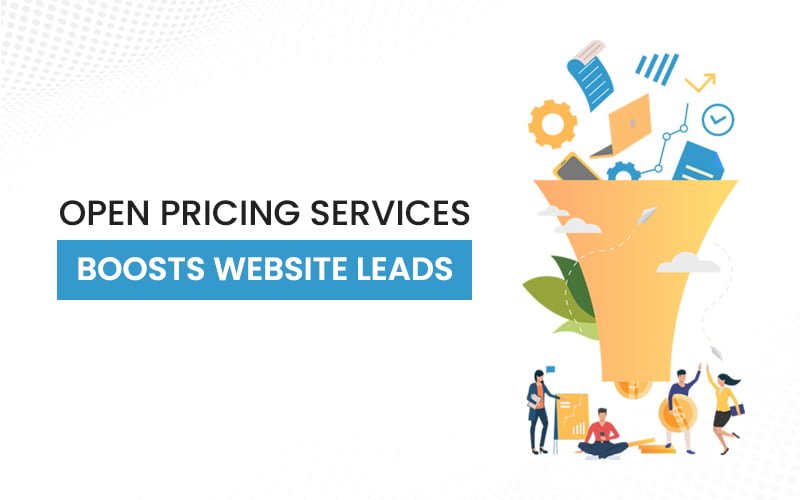
Businesses that display pricing openly on their websites generate more leads, better-quality leads and shorter sales cycles than those that hide it. Visitors who arrive at a pricing page are among the highest-intent visitors on any website they have moved past curiosity into active consideration. And a pricing page that ranks in Google for “pricing-related” and “cost-related” search terms captures buyers at exactly the moment they are closest to making a decision.
This post makes the case for open pricing services as both a conversion strategy and an SEO strategy and gives you a practical framework for implementing it in a way that works for your specific business model.
Here are a few reasons that you should go for open pricing of services:
Reason 1 – Trust and Credibility
Open Pricing Builds Trust and Credibility
Trust is the primary currency of any service business relationship. Before a prospect will pick up the phone, fill in a form, or hand over their credit card details, they need to believe that the business they are dealing with is honest, competent and aligned with their interests.
Pricing transparency is one of the fastest ways to establish that trust because it signals that you have nothing to hide. A business that openly states what it charges is implicitly saying: we are confident in the value we deliver and we respect your time enough not to make you jump through hoops to find out if we are affordable.
Conversely, a business that withholds pricing can trigger the opposite inference. Many buyers, particularly those who have been burned by hidden fees or bait-and-switch pricing in the past, interpret “contact us for pricing” as a warning sign rather than an invitation. The absence of pricing creates uncertainty and uncertainty is the enemy of conversion.
This trust dynamic is especially powerful in service businesses where the buyer cannot physically inspect what they are purchasing before committing. In digital marketing, web development, legal services, consulting and healthcare categories, where the service is intangible pricing transparency is one of the most accessible and impactful tools for building the initial trust needed to start a conversation.
Reason 2 – Price Points and Qualification
Displaying Price Points Saves Everyone’s Time – and Improves Lead Quality
Every sales conversation that ends in “sorry, that’s outside our budget” is a conversation that cost both parties time with zero productive outcome. Transparent pricing eliminates those conversations before they start.
When pricing is clearly displayed, visitors self-qualify before making contact. Those who reach out already know the approximate cost, have decided it is within consideration and are calling to understand the specifics of what they will get not to determine whether they can afford it. This shift transforms your inbound enquiries from a mixed pool of curious browsers and unqualified leads into a curated pipeline of serious, budget-aware prospects.
For service businesses with a defined minimum engagement value, this is particularly significant. If your web design projects start at ₹50,000, displaying that starting price will eliminate enquiries from businesses expecting to pay ₹5,000, saving your team the time of explaining the discrepancy and saving the prospect the disappointment of discovering it three calls into the process.
The net effect on the sales team is measurable: fewer total calls, but a higher proportion of calls that convert into paying clients. The quality of your pipeline improves precisely because the pricing information has already done the first-pass qualification for you.
Reason 3 – Beliefs About Unaffordability
Hiding Prices Creates a Perception of Unaffordability
One of the most counterproductive consequences of withholding pricing is that it does not leave the visitor’s perception neutral it actively pushes it negative. When no price is shown, the human mind fills in the gap and it almost always fills it in pessimistically.
A visitor who cannot find a price will typically assume one of two things: either the service is too expensive for them, or the pricing is complicated and variable in ways that will be difficult to navigate. Neither conclusion motivates them to reach out. Both motivate them to leave.
Research into consumer psychology consistently shows that price uncertainty is more damaging to conversion than a price that is slightly higher than expected. A prospect who sees a price that is at the top of their budget will often find a way to justify the investment if the value is communicated well. A prospect who sees no price at all rarely gives you the chance to make that case.
This is particularly relevant for businesses in the mid-market range not luxury or ultra-premium pricing, where withholding price can occasionally serve a brand positioning purpose, but the more common scenario of professional services priced accessibly for small and medium businesses. Hiding a reasonable price achieves nothing except losing the visitors who would have converted.
Reason 4 – Sales Effectiveness
Open Pricing Makes Your Sales Process More Effective
When pricing is withheld, the sales process begins with a negotiation about access to information rather than a conversation about value. The prospect’s first question is “what does it cost?” which means the first call is spent on a topic that the pricing page could have resolved in 10 seconds. This is an inefficient use of your sales team’s most valuable resource: time spent in conversation with genuinely interested prospects.
Open pricing restructures the sales conversation entirely. When a prospect calls having already reviewed your pricing page, they are not asking “can I afford this?” they are asking “is this the right fit for my specific situation?” That is a fundamentally more productive conversation, one that allows your team to focus on understanding the prospect’s goals, demonstrating expertise and building the confidence needed to close.
There is also a closing rate benefit. Prospects who have self-qualified through your pricing page enter the sales conversation with a higher level of commitment than cold enquiries. They have already invested time in understanding your offering and have not been scared off by the price which means the primary remaining hesitation is typically about fit and confidence, not budget. These are easier objections for a skilled sales team to address than budget constraints discovered mid-call.
Reason 5 – Branding and Competitive Positioning
Pricing Is a Branding Decision, Not Just a Commercial One
How you price your services and how transparently you communicate that pricing sends a clear signal about where your business sits in the market and what kind of clients you are seeking to attract.
A business that publishes clear, confident pricing is positioning itself as professional, organised and customer-respecting. It communicates that it has thought carefully about its value proposition, that it treats all potential clients with equal transparency and that it is not in the business of negotiating different prices for different people based on how much it thinks it can extract.
For premium service businesses, this signal is particularly powerful. Counterintuitively, displaying a high price often increases rather than decreases perceived quality because it communicates confidence in the value being delivered. A business that apologetically hides its pricing, by contrast, may inadvertently suggest insecurity about whether that value can be justified.
Your pricing also positions you relative to competitors. A prospect comparing three agencie, all of whom say “contact us for pricing” and one that shows a clear, well-structured pricing page will almost always explore the transparent option first. That head start in the consideration process is a meaningful competitive advantage that costs nothing to establish beyond the decision to be open.
Some advice on pricing your services or products:
How to Display Pricing on Your Website for Maximum Impact
Deciding to show pricing is the first step. How you display it determines how effectively it converts. Here is a practical framework:
Show “starting from” prices where exact pricing varies For service businesses where the final price depends on scope, showing a starting price or price range is far more effective than “contact us.” “Website design starting from ₹45,000” immediately sets expectations and allows the visitor to self-qualify without committing you to a fixed price before understanding the brief. This approach works well for web development, digital marketing retainers, legal services and any other field where pricing is genuinely variable.
Use a tiered pricing table to frame value Packaging your services into 2–4 tiers (commonly labelled Basic / Standard / Premium, or Starter / Growth / Enterprise) does two things simultaneously. It gives visitors a clear set of options to choose from reducing the decision paralysis that a blank “contact us” page creates. And it uses pricing psychology to anchor perception: the middle tier almost always becomes the most popular choice because it looks reasonable compared to both extremes.
Connect price to outcomes, not just deliverables The most effective pricing pages do not just list what is included, they connect each tier or package to a specific business outcome. “Suitable for businesses looking to establish local search visibility” is more compelling than “includes 5 blog posts per month and basic keyword research.” Outcome-led pricing descriptions reduce the perceived risk of the investment and help visitors self-select the tier that matches their goals.
Use the pricing page as an SEO asset Search queries that include pricing, cost, or packages are among the highest-intent keywords in any service category. A well-optimised pricing page targeting terms like “SEO packages India,” “digital marketing cost in Gurgaon,” or “website design price” will attract visitors who are actively comparing options and ready to make a decision. This is traffic that converts at significantly higher rates than general informational traffic and it is traffic your competitors without pricing pages are not capturing.
Consider a downloadable pricing guide for complex services For highly custom or enterprise-level services where a single page cannot capture pricing nuance, a downloadable pricing guide accessible via a short email capture form combines the benefits of pricing transparency with lead generation. Visitors get the information they came for; you capture their email address for follow-up. This approach works particularly well for B2B services with long decision cycles.
Keep it maintained A pricing page with outdated rates or discontinued packages is worse than no pricing page at all it creates false expectations that erode trust the moment a sales conversation reveals a discrepancy. Review and update your pricing page every time rates change and include the date of last update if pricing is particularly time-sensitive in your industry.

Pricing “page” gets to your website, those people who are seriously interested in buying (while also improving your Google rankings!)
“pricing-related”, “packages-related” and “cost-related” phrases are extremely commonly searched keywords eg. SEO packages. If you mention costs on your website, you could see a significant increase in Google traffic to your site.
Hope this article helps you in your decision of whether to go for open pricing or not.
Retainer vs Project: Which Pricing Model is Right for You?
Once you’ve decided to display your pricing openly, which, as we’ve covered, is almost always the right call, the next question is: what kind of pricing should you be showing?
For service-based businesses, this usually comes down to two models: a monthly retainer or a fixed project price. Both are legitimate. Both can be displayed transparently. But they serve very different kinds of work and choosing the wrong model, or failing to explain it clearly on your website, can cost you good clients.
What is a Retainer Model?
A retainer is an ongoing monthly engagement where the client pays a fixed fee in exchange for a defined set of services delivered every month. Think of it like a subscription to a team rather than a one-time purchase.
Retainer works best for:
- Services that require continuous effort, SEO, social media management, Google Ads, content marketing and website maintenance
- Businesses that want consistent output and month-on-month growth
- Clients who want a dedicated team that understands their brand deeply over time
- Work where results compound, the longer you do it, the better the returns
What clients get with a retainer:
- Predictable monthly cost, easy to budget
- A team that learns your business, your audience and your goals
- Ongoing optimisation, strategies are refined based on real performance data
- Priority support and faster turnaround since you are an active client
What to display on your website: Show a starting price or a price range. “Starting from ₹X per month” is far better than “pricing on request.” You do not need to list every variable, just give prospects enough to know whether they’re in the right ballpark before picking up the phone.
What is a Project-Based Model?
A project price is a one-time fixed fee for a clearly scoped deliverable. The work has a defined start, a defined end and a defined output. Once delivered, the engagement closes unless a new project or retainer begins.
Project works best for:
- Website design and development
- One-time audits, SEO audit, Google Ads audit, website performance audit
- Logo design, brand identity, copywriting
- App development or software builds
- One-time campaign setup, Google Ads account setup, email marketing setup
What clients get with a project:
- Clear scope, they know exactly what they’re paying for
- No ongoing commitment is good for businesses that want to test before committing long-term
- A fixed budget with no monthly surprises
- Full ownership of the deliverable once completed
What to display on your website: A fixed price where possible, or a “starting from” price with a brief note on what drives cost variation. For complex projects like web development, a price range with a “get a custom quote” CTA works well.
Side-by-Side Comparison
| Retainer | Project | |
|---|---|---|
| Best for | Ongoing services | One-time deliverables |
| Pricing | Monthly fixed fee | One-time fixed fee |
| Commitment | Ongoing (usually 3–6 month minimum) | Time-bound |
| Results | Compound over time | Delivered at completion |
| Examples | SEO, Ads, Social Media, AMC | Website, Audit, Branding |
| Budget predictability | High | High |
| Flexibility | Medium | High |
Which should you Choose?
The honest answer is that many businesses need both at different stages.
A startup launching a new brand needs a project first: build the website, set up the brand and create the base. Once that foundation is in place, they move to a retainer to drive traffic, generate leads and grow consistently.
An established business with a working website but inconsistent leads almost always benefits more from a retainer because their problem is not a one-time fix, it is ongoing visibility and conversion.
If you are unsure which model applies to your business, the simplest question to ask is this: Is your problem a one-time problem or an ongoing problem?
One-time problem → Project. Ongoing problem → Retainer.
Most digital marketing challenges ranking on Google, generating consistent leads, staying visible on social media, are ongoing by nature. Which is why, for most growing businesses, a retainer with a clearly defined scope and transparent monthly pricing tends to deliver the best long-term value.
The debate about whether to display pricing on your website has a clear answer for the vast majority of businesses: yes, you should and the way you display it matters as much as the decision to do so.
Transparent pricing attracts better-fit prospects, builds trust before the first conversation, shortens your sales cycle and creates a high-converting SEO asset that works for your business 24 hours a day. The businesses that treat their pricing page as a strategic tool rather than a necessary evil, consistently generate more qualified leads, close at higher rates and build the kind of reputation that compounds over time.
Whether you are considering displaying your service prices for the first time, restructuring your existing pricing page to improve conversion, or looking to combine a strong pricing strategy with a broader digital marketing plan, Digital Hive can help.
Explore our SEO packages to see transparent pricing in action or contact our team today to discuss how open pricing and the right digital marketing strategy can work together for your business.
FAQs
Open pricing means clearly displaying the cost of products or services on your website so visitors can make informed decisions without needing to inquire first.
When users see transparent pricing, it builds trust and reduces hesitation, making them more likely to take action or contact your business.
Clear pricing saves time for users, eliminates confusion and creates a smoother buying journey, which improves engagement and conversions.
Yes, not showing pricing can create friction and uncertainty, causing potential customers to leave your website without converting.
Yes, when users already know your pricing, the leads you receive are more serious and relevant, improving conversion rates and sales efficiency.
Transparent pricing shows honesty and professionalism, helping build long-term trust and credibility with your audience.
Digital Hive helps businesses design user-friendly websites with clear pricing structures that improve transparency, engagement and lead generation.
Yes, Digital Hive combines UX design, SEO and conversion optimization to ensure your website attracts high-intent visitors and converts them into quality leads.
Digital marketing costs in Gurgaon can vary based on your business size, competition and marketing goals. Small businesses typically spend between ₹15,000–₹40,000 per month for services like SEO, social media and Google Ads, while larger or more competitive campaigns can range from ₹50,000 to ₹2,00,000+ monthly. Pricing depends on factors such as the number of channels managed, ad spend, content requirements and campaign complexity.
It depends on your business needs. Project-based pricing works well for one-time services like website design, audits, or campaign setup. Monthly retainers are usually more effective for ongoing digital marketing activities such as SEO, Google Ads, social media management and content marketing because they require continuous optimization and monitoring for long-term results. Many growing businesses prefer retainers because they provide consistent strategy, reporting and performance improvements over time.
Digital marketing pricing varies because every business has different goals, industries, competition levels and service requirements. A local business targeting one city will need a very different strategy compared to an ecommerce brand running nationwide campaigns. Pricing also changes based on the experience of the agency, content production, technical expertise, advertising budgets, reporting depth and whether services are outsourced or managed in-house. Transparent agencies like Digital Hive focus on customized strategies and clear deliverables instead of one-size-fits-all pricing.