When you approach a website development company, you’ll usually hit one question early on: custom-built or template-based? It sounds like a minor styling choice, but it’s not. Custom vs Template Website Design actually shapes how your brand looks, how fast your site performs, and how easily it scales as your business grows. Templates promise speed and savings; custom builds promise something built around how you actually work. Most agencies won’t spell out the trade-offs upfront, leaving businesses to learn them the hard way. Here’s the honest breakdown, no jargon, so you can make the right call from the start.
What is a Template Website?
A template website is like buying a ready-to-wear outfit. It’s pre-designed and can be deployed faster. Website design company love templates because they cut down on development time and resources.
You pick a theme, add your content and go live. Sounds good, right? But here’s the catch…
The Limitations of Template Websites
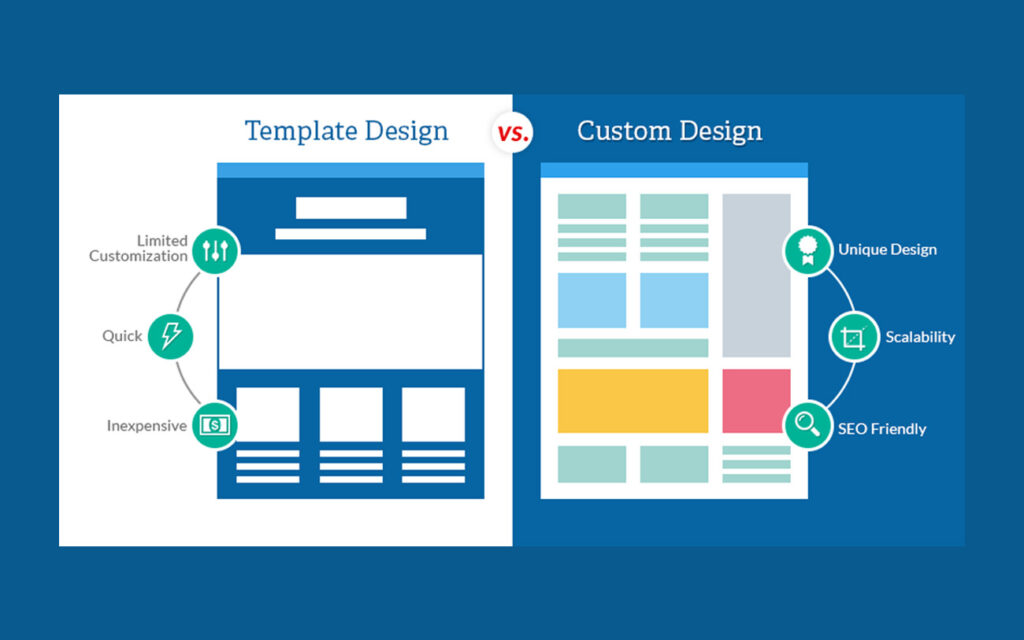
- Limited customization: Most templates are built with fixed layouts. You can change colours, fonts and images—but altering structure or functionality often leads to clunky code or broken designs.
- SEO restrictions: Templates might not be fully optimized for speed, responsiveness, or technical SEO needs. That can hurt your Google rankings in the long run.
- Generic feel: Many other businesses may be using the same template, making it hard for your brand to stand out.
- Scalability issues: Want to add custom features later, like booking integrations or dynamic dashboards? That’s where most templates fall flat.
What is a Custom Website?
Think of a custom website as a tailored suit, crafted to fit your brand’s voice, functionality needs and long-term goals.
When a website development company builds a site from scratch, everything—from the user flow to backend performance—is designed with your business in mind.
Why Custom Websites Are a Long-Term Win
- Brand identity on point: Every detail reflects your brand’s personality, from custom UI elements to strategic layouts that guide visitors toward conversion.
- Full control over SEO: Developers can fine-tune your code for faster load times, schema markup, accessibility and other advanced SEO advantages.
- Custom functionalities: Whether you need a multilingual setup, lead-scoring CRM, or a real-time inventory system—custom builds deliver.
- Scalable for growth: As your business evolves, your website can scale without hitting structural limits.
But Here’s What They Don’t Tell You…
When agencies talk about Custom vs Template Website Design, the conversation often stays surface-level, colors, fonts, layouts. But the differences that actually affect your business sit underneath:
Performance is one. Templates are often loaded with code and features you’ll never use, built to be flexible for thousands of different businesses. That extra weight slows load times, which affects both user experience and search rankings. Custom builds carry only what your site actually needs.
Scalability is another. As your business grows, your website needs to grow with it, new features, new integrations, new ways of presenting your offerings. Templates have ceilings. At some point, you’ll hit a wall where the template simply can’t do what you need, and you’ll be migrating to a custom build anyway, except now with more content and more at stake.
And then there’s brand differentiation. In crowded markets, looking like everyone else is a real cost. A custom site lets your visual identity actually mean something, rather than blending into a sea of businesses running the same theme.
Many website design companies push templates because they’re easier to sell, faster to deliver and more profitable in the short term.
Custom websites demand more skill, time and understanding of your business—something not every agency is equipped or willing to offer.
You might also hear, “Templates are just as good as custom builds today.”
That’s partly true—but only if your goal is to have a digital brochure, not a business-generating platform.
How to Decide: Custom vs. Template?
There’s no universal answer, despite what some agencies will tell you to push you toward the more expensive option. If you’re validating an idea, working with a tight budget, or need something live fast, a template can absolutely do the job. But if your brand identity, user experience, or long-term growth plans matter to you, custom development is the investment that pays off over time rather than becoming a constraint you have to work around later. The honest move is to have this conversation with your developer before signing anything, not after you’ve outgrown a template and need to start over.
Ask yourself:
- Is your website critical to your sales funnel?
- Do you plan to scale or add new features in the future?
- Is brand differentiation important in your industry?
- Do you want to optimize aggressively for SEO?
If you answered “yes” to most of these, a custom website is your best bet—even if it takes a little longer or costs a bit more upfront.
Final thoughts,
At the end of the day, your website is more than just pixels on a screen—it’s your first impression, your digital storefront and often, your most important marketing asset.
While templates may seem like the faster, cheaper route, they come with hidden trade-offs that can limit your brand’s growth and visibility. A custom website, crafted by a professional website development company, offers the flexibility, scalability and performance your business truly deserves.
So before you settle for the easy option, ask yourself: Do you want to fit in—or stand out?
FAQs
A custom website is built from scratch based on your business needs, while a template website uses pre-designed layouts that are slightly customized for your brand.
A custom website offers more flexibility, scalability and unique branding, while templates are quicker and cheaper but come with limitations in design and functionality.
Templates are faster to build and more affordable, making them easier to sell to clients who want quick results or have a limited budget.
Templates often have limited customization, generic designs and restricted scalability, which can make it harder for your brand to stand out or grow over time.
Custom websites are built with clean code, faster loading speeds and better structure, which helps improve search engine rankings and user experience.
Not necessarily, but they can limit long-term growth because they may not support advanced features, scalability, or unique branding as your business expands.
Custom websites require more time, planning and development effort, which increases the overall cost compared to ready-made templates.
Choose a custom website when you need a unique brand identity, advanced functionality, better performance and long-term scalability for your business.
Digital Hive helps businesses make the right website development choice based on their goals, budget, scalability needs and long-term growth plans. Whether you need a cost-effective template-based website or a fully customized solution, our team provides expert guidance, design, development, SEO optimization and ongoing support. We create websites that are fast, secure, mobile-friendly and optimized for search engines while ensuring they align with your brand identity and business objectives. By evaluating your current and future requirements, Digital Hive helps you invest in a website solution that delivers the best value, performance and return on investment.