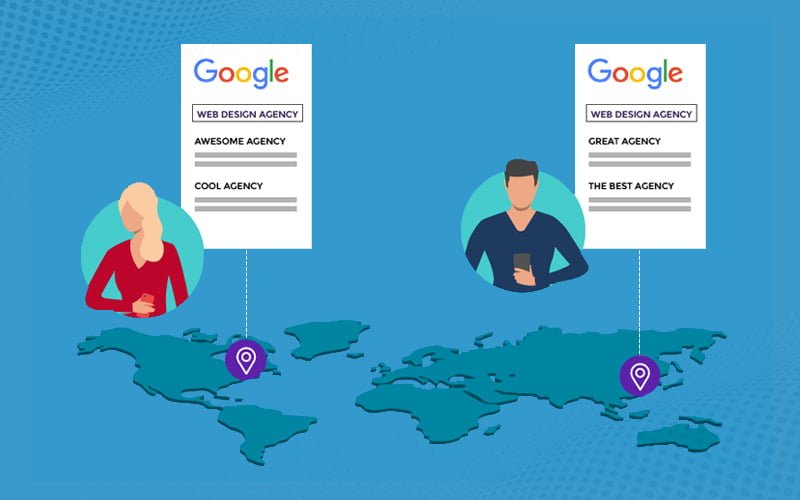
Type the exact same search query into Google right now on your phone, then ask a colleague to type the same thing on their laptop across the room. The results will very likely differ, sometimes subtly, sometimes significantly.
This is not a glitch. It is Google working exactly as intended.
Google’s stated mission is to organise the world’s information and make it universally accessible and useful. The operative word is useful and what is useful to one person in one context is not the same as what is useful to another person in a different context. A search for “best restaurant near me” typed by someone in Gurgaon should not return the same results as the same query from someone in Mumbai. A search for “SEO services” typed by someone who has previously researched enterprise marketing platforms should not return the same results as the same query from a small business owner researching for the first time.
To deliver this level of relevance, Google has built a sophisticated personalisation engine that considers dozens of signals, location, browsing history, device type, account data, language, time of day and more every time a search is performed. The result is that no two users experience exactly the same Google.
For businesses investing in SEO services, understanding why organic search results differ from user to user is not just intellectually interesting, it is strategically essential. It explains why your website appears on Page 1 when you search for it but a client in another city cannot find it. It explains why rank tracking tools give different numbers than manual searches. And it shapes how a smart SEO strategy should be built and measured.
In this blog, we break down every major factor that causes organic search results to differ and what it means for your business’s SEO approach.
1. Location
Location is arguably the single most powerful personalisation signal in Google’s algorithm — and it operates at a much more granular level than most people realise.
Google uses multiple methods simultaneously to determine a user’s location: their device’s GPS coordinates (the most precise), their IP address (less precise but always available), their Wi-Fi network location, their Google Maps usage history and location preferences set within their Google Account. When these signals conflict — for example, if a user’s IP address suggests they are in Delhi but their GPS shows Gurgaon — Google typically prioritises the more precise signal.
How location affects search results in practice:
For queries with local intent — “SEO company near me,” “best café in Sector 29,” “plumber in Gurgaon”, Google serves a Local Pack (the map with 3 business listings) above the organic results. These listings are entirely driven by proximity, relevance and the quality of a business’s Google Business Profile. Two users searching the same query just 2–3 kilometres apart may see entirely different businesses in that local pack.
Even for queries that do not appear inherently local, such as “digital marketing agency” or “eCommerce website design” — Google still factors in location. A user in Gurgaon is more likely to see results featuring agencies based in Gurgaon or Delhi NCR, even if they have not typed a location into their query.
For businesses, this means that ranking “nationally” requires a very different strategy from ranking for specific cities. A business targeting customers in Gurgaon, Jaipur and Delhi should have dedicated location pages optimised for each city, not a single generic service page. This is why local SEO is a core component of any comprehensive SEO strategy, not an optional add-on.
2. Online search habits and history
Google obtains information in two ways:
Google Account: Google can monitor and view the browsing history of everyone with a Google Account.
Cookies: Google examines web cookies stored on browsers for anonymous users (those who are not enrolled in a Google account).
They collect the following types of information:
Your past behaviour on Google shapes what Google shows you in the future. This is the personalisation layer that most visibly distinguishes one user’s experience from another and it operates whether or not you are signed into a Google account.
How Google collects and uses your search history:
When a user is signed into their Google Account, Google can access a comprehensive picture of their activity, every search they have performed, every result they clicked, every website they visited, every video they watched on YouTube and (if enabled) their location history. This data builds a detailed interest profile that influences search result rankings.
For users who are not signed into a Google Account, personalisation still occurs through browser cookies — small data files stored locally on the device that track browsing behaviour across sessions. Even anonymous users see personalised results based on what they have recently searched and clicked.
Practical examples of how search history changes results:
- A user who has repeatedly visited a particular brand’s website will see that brand rank higher in their personal results, even if that brand does not hold a top position in general search rankings
- A user who frequently searches for topics related to a specific industry will see more results from that industry, even for queries that could apply across multiple sectors
- A user who has clicked on a particular type of content (video vs article, news vs evergreen) will see more of that content type surfaced for related queries
What this means for SEO:
It means that when you search for your own website on Google, you will almost always see it ranked higher than it actually ranks for a general user. Your browsing history has trained Google to believe your site is highly relevant to your searches. This is why manual rank-checking is an unreliable measurement method — and why SEO professionals use dedicated rank tracking tools, Google Search Console and incognito browsing to get an accurate picture of real-world rankings.
3. Device
The device from which a search is performed — mobile, desktop, or tablet — influences search results in several significant ways.
Mobile-first indexing is the most important device-related factor in modern SEO. Google now uses the mobile version of a website as the primary version for indexing and ranking decisions. This means that a website which performs well on desktop but loads slowly or displays poorly on mobile will be ranked based on its mobile performance, even for desktop users. If your mobile site is inferior to your desktop site, your rankings suffer across all devices.
Beyond indexing, the results themselves can differ between mobile and desktop:
- Local results are amplified on mobile — because smartphones have precise GPS tracking, mobile searches surface significantly more location-based results than the same query on a desktop with only IP-based location detection
- Featured snippets and rich results display differently — answer boxes, knowledge panels and local packs take up more visible screen space on mobile, pushing organic results further down
- Voice search from mobile produces answer-based results rather than a list of blue links — optimising for voice queries (typically longer, conversational, question-based phrases) is increasingly important as voice search usage grows
- App indexing — Google can surface content from installed apps in mobile search results for signed-in users, an additional layer of personalisation that does not exist on desktop
For businesses, this underscores why mobile optimisation is not optional — it is the primary battleground for organic rankings. A site that has not been tested thoroughly on mobile, that has slow load times on mobile connections, or that presents a degraded mobile experience is compromised in rankings for both mobile and desktop users.
4. Google Accounts
When a user is signed into their Google Account, the level of personalisation they experience in search results goes considerably deeper than cookie-based personalisation for anonymous users.
Google’s signed-in personalisation draws from a much richer data set: not just browsing history, but Gmail content (used to infer interests and intent), Google Maps searches and saved locations, YouTube watch history, Google Shopping activity, Calendar events and the full history of searches performed while signed in, across all devices linked to the account.
This cross-device, cross-service picture of a user’s behaviour allows Google to make significantly more nuanced personalisation decisions. A user who has been researching accounting software for several weeks will see different results for a generic query like “business management tools” than a user who has been researching marketing platforms, even if both queries are identical.
The Google Account personalisation gap:
The difference between the results seen by a signed-in user and an anonymous user can be substantial for competitive or broad queries. A signed-in user with a well-developed interest profile will see results that are highly tailored to their established preferences. An anonymous user sees results that are less tailored, closer to what Google considers a general baseline ranking for that query.
This matters for SEO reporting and client communication: when clients say “I searched for our keyword and we were not on Page 1,” the account-level personalisation of their search may be showing them a very different result set from what a prospective customer with no prior exposure to the brand would see.
5. Time
The time and date of a search influence organic results in two distinct ways: query-specific time sensitivity and ongoing algorithm fluctuation.
Time-sensitive queries: For searches where recency matters, news, events, trending topics, financial information, sports results, Google’s freshness algorithm prioritises recently published or updated content. A search for “digital marketing trends” performed in January will surface different articles from the same search performed in September, because Google is actively seeking to serve the most current information available.
This is why regularly updating existing content on your website — not just publishing new articles — is an important SEO practice. A well-optimised page that was published two years ago but has been refreshed with current data and examples will generally outperform the same page left static, for queries where freshness is a ranking signal.
Continuous algorithm testing: Google runs thousands of ranking experiments simultaneously. At any given moment, different users may be served results from different variations of the algorithm as Google tests which version produces better engagement and satisfaction signals. This means that search results can shift not just day to day, but hour to hour, as Google refines its ranking models in real time.
This is another reason why tracking rankings over a meaningful time period, rather than reacting to day-to-day fluctuations, is the only reliable way to assess SEO performance.

Additional Factors That Cause Organic Search Results to Differ
Beyond the five primary factors covered above, several additional signals contribute to the organic search results difference between users:
6. Language and Region Settings Google’s interface language and region settings affect which results are prioritised. A user with their browser set to Hindi and their region set to India will see different results from a user with English (US) settings, even for the same query typed in English. For businesses targeting multilingual audiences or specific regional markets, this makes language-specific content and hreflang tags important SEO considerations.
7. SafeSearch Settings Users with SafeSearch enabled will see results with certain content types filtered out. While this primarily affects adult content categories, it can also influence results in health, wellness and certain retail verticals.
8. Search Intent Interpretation Google does not just match keywords — it interprets intent. The same string of words can be read as informational (the user wants to learn), navigational (the user wants to reach a specific website), or transactional (the user wants to buy or enquire). Google’s intent classification of a query can shift based on the user’s recent behaviour and profile, meaning two users typing identical queries may see a different mix of results, some informational, some transactional, depending on what Google believes each user is trying to accomplish.
9. AI Overviews and Generative Search Google has been rolling out AI-generated summaries at the top of search results pages for certain query types. These AI Overviews (part of Google’s Search Generative Experience) appear differently for different users based on their Google account status, device, location and query type and can significantly change the structure of the results page that different users see for the same search.
What the Organic Search Results Difference Means for Your SEO Strategy
Understanding why search results differ from user to user is not just theoretical knowledge — it has direct, practical implications for how you build and measure your SEO strategy.
1. Do not track rankings by searching manually
The single most common mistake businesses make in SEO measurement is Googling their own keywords to check rankings. Because your search history has conditioned Google to elevate your site in your personal results, manual searches will almost always overstate your actual ranking. Use Google Search Console (which shows average position across all users, not just your personalised view), or a dedicated rank tracking tool like Ahrefs, SEMrush, or SERPWatcher to get accurate ranking data.
2. Invest in local SEO if you serve specific geographies
Because location is the dominant personalisation factor for most commercial queries, businesses targeting customers in specific cities must have dedicated local SEO in place. This means optimised Google Business Profiles, location-specific landing pages, local citations and a review generation strategy. Ranking well in Gurgaon requires different optimisation than ranking well in Jaipur — even for the same service.
3. Build for breadth, not a single rank position
Because different users see different results, a business that ranks first for one user may rank fifth for another. The most resilient SEO strategy does not obsess over a single position for a single keyword — it builds visibility across a broad range of relevant search terms at different stages of the buyer journey, so the business is findable regardless of how personalisation shifts results for individual users.
4. Optimise for intent, not just keywords
Because Google interprets the same search query differently for different users based on their intent signals, content that serves a specific, well-defined intent consistently outperforms generic content that tries to serve all users with one page. For each target keyword, understand whether the dominant intent is informational, commercial, or transactional and build content that serves that intent precisely.
5. Keep content fresh
Because time is a personalisation factor, regularly updating your most important pages with current information, data and examples signals to Google that your content is actively maintained, making it more likely to be surfaced for time-sensitive queries.
6. Use personalisation as a targeting advantage
The fact that results are personalised is not a threat to SEO — it is an opportunity. A business that consistently provides relevant, high-quality content to its target audience builds a presence that Google’s personalisation engine will learn to associate with those users’ interests. Over time, users who have engaged with your content are more likely to see it resurface, creating a compounding visibility advantage that reinforces brand recognition and trust.
The fact that Google serves personalised organic search results is not an obstacle to SEO — it is a signal of where the discipline is heading. Google is continuously getting better at understanding individual users, their context and their intent. Businesses that invest in SEO strategies built around genuine relevance, the right content, for the right audience, in the right location, will consistently benefit from personalisation rather than being undermined by it.
Understanding why your search results differ from your customers’ results is the first step to building an SEO strategy that reaches them accurately, not just in your own browser window.
If you want a clear picture of where your business actually ranks for the keywords that matter and a strategy to improve those rankings, Digital Hive can help. Explore our SEO packages or contact our team today for a free, no-obligation audit.
FAQs
Google personalises search results based on a combination of signals including the user’s geographic location, device type, browsing and search history, Google Account data, language settings and the time of the search. Each of these factors influences which results Google considers most relevant for that specific user at that specific moment — meaning two people typing the exact same query can see meaningfully different results.
The organic search results difference is caused by Google’s personalisation algorithms, which continuously evaluate dozens of user-specific signals to determine the most relevant results. The primary causes are location (proximity to businesses and local relevance), personalised search history (past clicks, searches and browsing behaviour), device type (mobile vs desktop, with location precision differences), Google Account data (cross-service interest profiling) and the time of the search (freshness weighting for time-sensitive queries).
Yes — significantly. Location is one of the most powerful ranking factors, particularly for queries with local intent. Google uses GPS, IP address, Wi-Fi location and Maps history to determine a user’s location and prioritises businesses and content that are geographically relevant to that user. Two people searching the same query from different cities — or even different neighbourhoods in the same city — may see entirely different local results and different rankings for organic listings.
Yes. Google tracks searches performed, results clicked, websites visited and content engaged with — both for signed-in users through their Google Account and for anonymous users through browser cookies. This behavioural data trains Google to surface content that aligns with a user’s demonstrated interests and preferences, meaning a user who has repeatedly engaged with a particular website or topic will see that content ranked higher in their personal results than it appears for a general user.
Yes. Search results differ between devices for several reasons: mobile devices provide more precise location data (GPS vs IP), which amplifies local results; the mobile results page layout gives more prominence to features like the local pack and featured snippets; and Google uses mobile-first indexing, meaning a website’s mobile performance is the primary basis for its rankings across all devices. Businesses with a poor mobile experience therefore suffer ranking disadvantages even for desktop searches.
Personalisation means that no single ranking position represents the universal truth of where a website ranks. Different users see different results, so businesses should not rely on manual rank-checking to assess SEO performance. Instead, they should use Google Search Console for average position data, invest in broad keyword coverage rather than obsessing over one position, build strong local SEO for geographic targeting and focus on content that serves clear user intent — all of which produces visibility that holds across personalisation variations.
Incognito mode reduces personalization effects from browsing history, but results may still vary based on location, language and search engine settings.
Businesses can improve visibility through keyword optimization, high-quality content, technical SEO, mobile responsiveness and local SEO strategies.
Digital Hive provides SEO services including technical optimization, keyword strategy, content development, local SEO and performance tracking to improve organic search visibility.