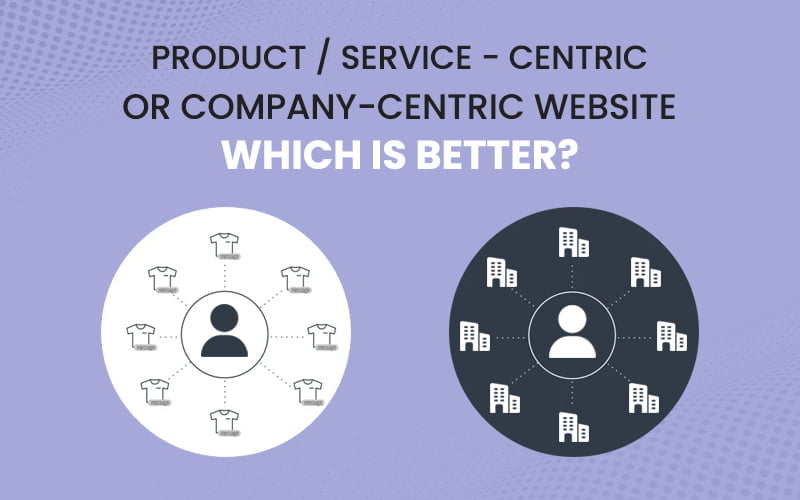
When businesses set out to build or redesign their digital presence, one of the most critical decisions they face is the Company-Centric vs Product-Centric Website debate. Each strategy has advantages and disadvantages and the optimal choice ultimately relies on the particular business and its objectives.
Product or service-centric websites concentrate on the products or services offered by a company. Websites that are company-centric, on the other hand, emphasize the business and company values. Which one will suit your business requirements?
What Is a Product-Centric Website?
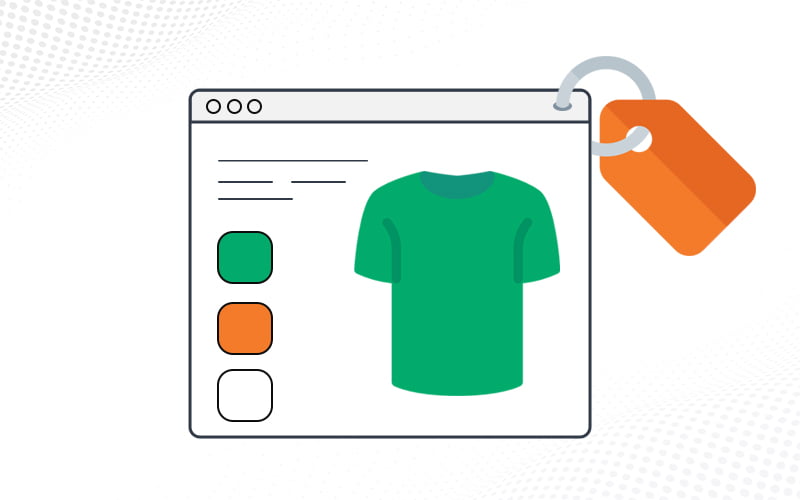
A product-centric (or service-centric) website places your offerings front and centre. Every page, every headline and every call-to-action is designed to answer one question: “What can this business do for me?”
Key characteristics of a product-centric website:
- Homepage hero sections highlight specific products or services
- Navigation is structured around service categories, not company history
- Landing pages are optimised for high-intent search queries
- Pricing, features and benefits are immediately visible
- CTAs are conversion-focused (e.g., “Get a Free Quote,” “Shop Now,” “Book a Demo”)
Best suited for: SMBs, startups, eCommerce stores, service-based businesses (agencies, consultants, clinics) and any business where the end-user is searching for a specific solution.
What Is a Company-Centric Website?
A company-centric website shifts the spotlight to the organisation itself — its legacy, leadership, vision, culture and values. Rather than leading with what you sell, it leads with who you are.
Key characteristics of a company-centric website:
- Prominent “About Us” and leadership sections
- Focus on brand story, milestones and mission statements
- Investor relations, press coverage and CSR pages
- Emphasis on trust signals like awards, certifications and global presence
- Less focus on individual product/service pages
Best suited for: Multinational corporations (MNCs), publicly listed companies, enterprise-level B2B organisations and well-established brands where the company name itself is the search intent.
Company-Centric vs Product-Centric Website: A Side-by-Side Comparison
| Feature | Product-Centric Website | Company-Centric Website |
|---|---|---|
| Primary focus | Products/Services | Brand & Company identity |
| Visitor intent match | High (solves a specific need) | Moderate (builds brand awareness) |
| SEO performance | Stronger for commercial keywords | Stronger for branded keywords |
| Conversion rate | Generally higher | Generally lower |
| Best for | SMBs, startups, eCommerce | MNCs, enterprises |
| User journey | Task-oriented | Discovery-oriented |
| Content tone | Problem-solving, benefit-led | Authority-driven, narrative |
Which Approach Wins for SEO?
From an SEO standpoint, the Company-Centric vs Product-Centric Website debate has a fairly clear answer for most businesses: product-centric wins for organic search traffic.
When a potential customer types “affordable web design company in Gurgaon” or “best running shoes under ₹3000” into Google, they are looking for a solution — not a company story. A product-centric website is structured to match that intent precisely, which means:
- Better keyword alignment with what users are actually searching for
- Lower bounce rates because visitors land on pages relevant to their query
- Higher dwell time as users explore service pages, pricing and features
- More qualified leads entering your conversion funnel
Company-centric websites, meanwhile, tend to perform well for branded searches — users who already know the company and are looking it up directly.
Can a Website Be Both? The Hybrid Approach
In reality, the sharpest distinction in the Company-Centric vs Product-Centric Website debate is not always black-and-white. A hybrid approach — which most successful businesses adopt — structures the website around products and services while also incorporating strong company credibility signals.
How to balance both:
- Lead with your solutions — Make products/services the centrepiece of your homepage and navigation
- Support with your story — Use a dedicated “About Us” section to build trust and authenticity
- Segment your audience — Use distinct landing pages for each buyer persona or service line
- Layer in social proof — Client testimonials, case studies and awards reinforce both the product value and company credibility
- Use internal linking strategically — Connect company-story pages back to relevant service pages to guide visitors toward conversion
Real-World Example: How the Choice Plays Out
Consider two businesses offering the same service — digital marketing.
Business A (Product-Centric): Their homepage immediately showcases “SEO Services,” “Google Ads Management,” and “Social Media Marketing” with clear pricing tiers and a “Get a Free Audit” button. A visitor searching for “SEO agency in Delhi” lands here, finds exactly what they need and converts.
Business B (Company-Centric): Their homepage opens with a company timeline, leadership profiles and a vision statement. The same visitor lands here, doesn’t immediately see service details and bounces back to search results.
The outcome of this Company-Centric vs Product-Centric Website comparison is clear — when user intent is transactional, a product-centric structure consistently outperforms.
Key Takeaway: Match Your Website to Your Business Stage
- Early-stage or growing business? Go product-centric. Your brand isn’t yet the selling point — your solution is.
- Established enterprise or publicly traded company? A company-centric approach can reinforce authority, attract investors and support talent acquisition.
- Most businesses? Adopt a hybrid model — let your products lead, your company story support and let data guide refinements over time.
The Company-Centric vs Product-Centric Website decision is not a one-time choice. As your business grows, your website strategy should evolve alongside it. Regular audits, user behaviour analysis and conversion tracking will help you identify when it is time to shift the balance.
Each strategy has advantages and disadvantages and the optimal choice ultimately relies on the particular business and its objectives.
Product or service-centric websites concentrate on the products or services offered by a company. Websites that are company-centric, on the other hand, emphasize the business and company values. Which one will suit your business requirements?
People typically use Google to search for goods and services. Your website must be relevant to the user’s search in order to keep them from bouncing back in seconds. Websites focused on products and services are preferred above those that are company-centric. As it is more likely to fulfill the user’s needs and complete its search journey on search engines.
Imagine someone looking for a website design company and conducting a Google search to find the company that best meets their needs. He ends up on a website that discusses website development packages and all of the services they offer in the first instance. The likelihood that the user will convert and give them business is high.

In the second scenario, if the user stumbles on a website that does not talk about the services but rather brags about the company, the user is unlikely to spend much time on the website as the purpose for the search is not being fulfilled and he is being served with company values, policies or how it was established. The engagement level will be lower, which will lead to a lower enquire rate.
MNCs are more likely to benefit from company-focused websites. A company-centric website emphasizes the firm rather than how its services can meet the demands of users. Since the firm itself is what they prioritize, rather than the services and products. This strategy is likely to be appropriate for large businesses and MNCs.
After selecting the right approach you are required to work on the website and ensure that your website gets the attention it deserves, try to follow these rules and develop a website that suits your business needs.
1. Recognize your audience.
It may seem obvious, but so many businesses begin writing—or typing—before considering their intended audience. Before creating material, consider the following: Who is my main target market? What about a supplementary audience that can sway and educate my main audience?
2. Adhere to the “inverted pyramid” principle
Web users have limited attention spans, so they’ll decide quickly if your site contains the information they need. Create your material in a pyramid or cone shape that is upside down. The page’s headings feature the most significant messages. Drill down gradually to the more detailed supporting information after that.
3. Use active voice
Put an emphasis on the topic of the sentence and use active verbs rather than passive ones. For instance, write “Place an order of products on our website” rather than “Products can be ordered on our website.”
4. Demonstrate rather than tell
Don’t confine your prose to broad generalizations and abstract ideas. Readers are more likely to comprehend and grasp your messages when you use specific, practical examples and statistics. Using examples and stats can immediately grab the attention of your visitor and keep them engaged
5. Use several media
According to research, the majority of the human brain is visual and humans digest visual data much more quickly than text. Additionally, an easy-to-read chart or graph can clarify a complex subject better than texts alone. Using compelling images, graphs and videos can help you grab the attention of the visitor.
It is clear that a product or service-centric website is the better choice for businesses. Such websites are more focused on providing information and converting visitors into customers, which leads to better ROI. If you are looking to get website design services, get in touch with Digital Hive today.
FAQs
A company-centric website focuses on the business, its history, achievements, team, values and overall brand identity rather than individual products or services.
A product-centric website is designed to highlight specific products or services with detailed features, benefits, pricing and user-focused content to drive conversions.
The best choice depends on your business goals. Product-centric websites work better for lead generation and sales, while company-centric websites help build trust and brand credibility.
Manufacturing companies often use company-centric websites to showcase infrastructure, certifications, production capabilities and industry experience to attract B2B clients.
Yes, product-centric websites usually target specific keywords related to products or services, helping improve search engine visibility and lead generation.
Absolutely. Many modern business websites combine company branding with detailed product or service pages to create a balanced digital presence.
A product-centric website structure generally improves conversions because it focuses on customer needs, solutions and clear calls-to-action.
Digital Hive helps businesses create customized company-centric and product-centric websites tailored for branding, SEO, lead generation and long-term digital growth.