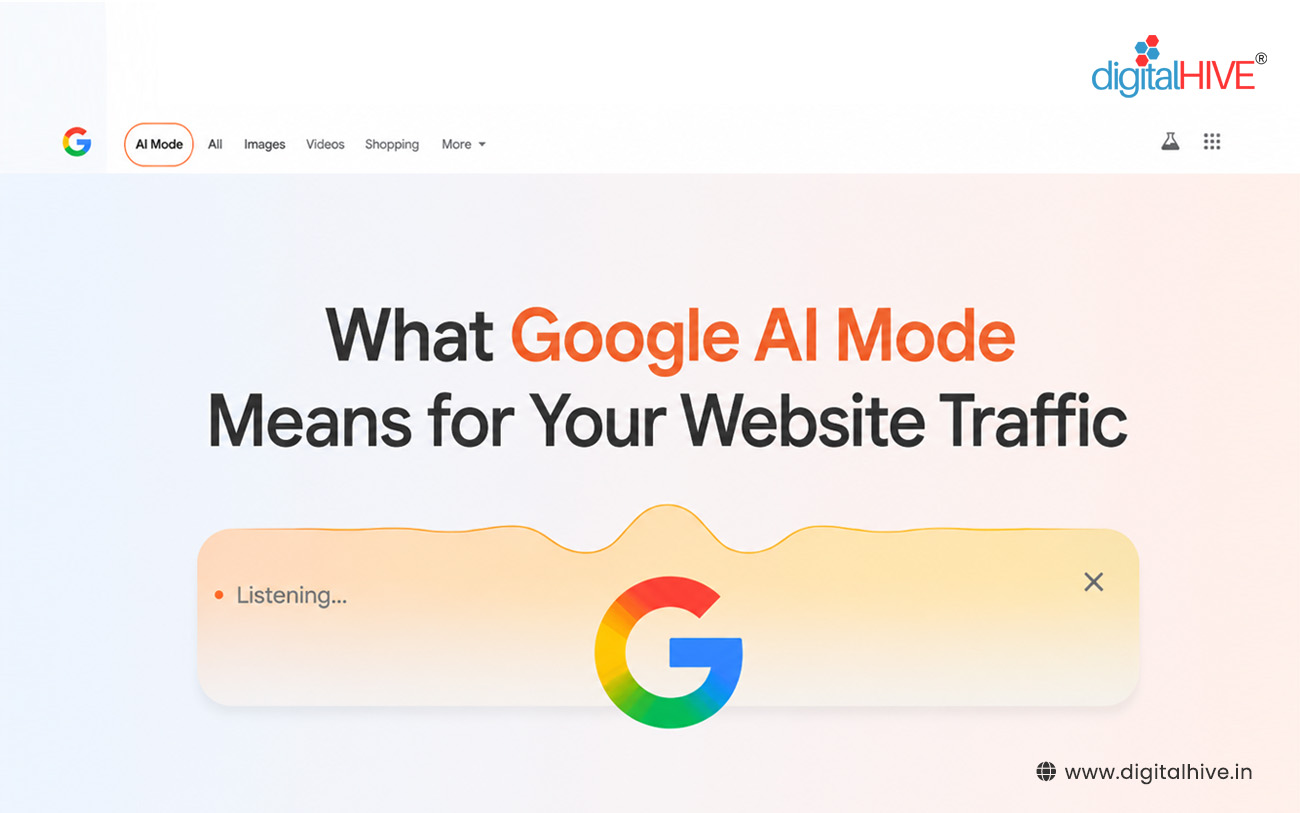
AI Overviews now appear in roughly 47% of Google searches in the US, according to Semrush data from early 2025. Click-through rates on organic results below an AI Overview drop by an average of 34%. Those numbers aren’t a warning about the future – they’re describing what’s happening right now. This piece explains the mechanics behind the shift, who gets hurt, who quietly benefits and what actually changes if you run a website.
What Google AI Mode Actually Does (and Doesn’t Do)
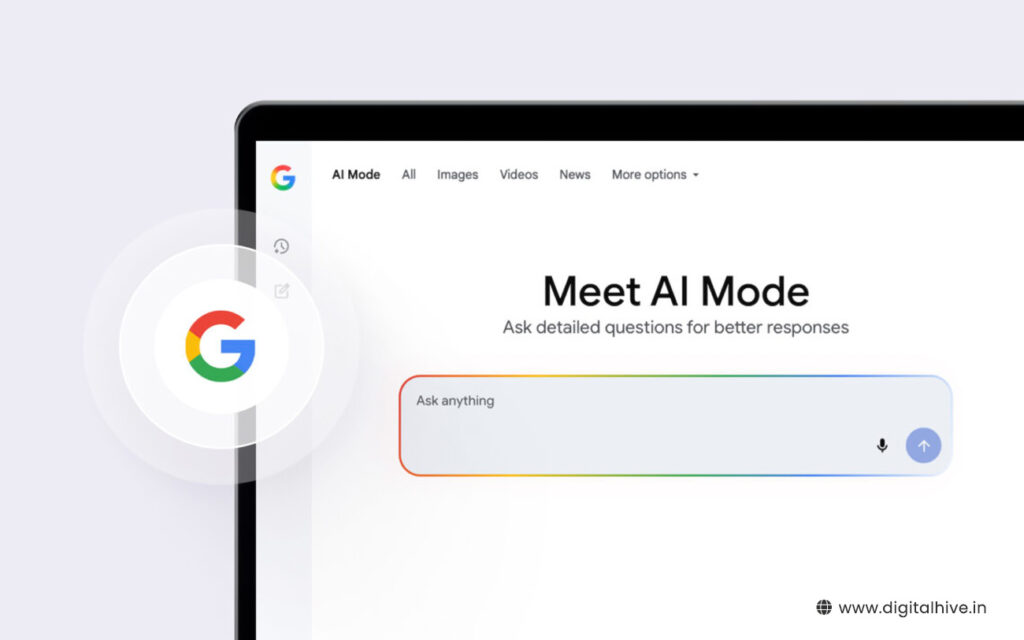
AI Mode – Google’s umbrella term for AI Overviews, conversational search and multi-step query handling – works by synthesizing information from multiple sources into a single response before the user sees any links. It’s not a featured snippet. It’s a full answer, generated on the fly, drawn from whatever pages Google’s models consider most authoritative on a given topic.
The crucial distinction is intent. AI Mode doesn’t treat all searches the same way. It tends to trigger heavily for:
- Definitional and explanatory queries (“what is”, “how does”, “why does”)
- Simple comparison questions (“X vs Y” where the answer is largely factual)
- How-to instructions with clear, repeatable steps
- Basic research and background information
It tends not to trigger or triggers with much weaker AI responses for:
- Transactional queries with commercial intent (“buy”, “hire”, “price”, “book”)
- Local searches with a specific geography
- Queries where recency matters (“latest”, “2025”, news, events)
- Queries that require personal or professional judgement
- Navigational searches for specific brands or tools
This split is the most important thing to understand before drawing any conclusions about what AI Mode means for your specific website.
AI Mode doesn’t destroy all search traffic equally. It surgically removes traffic from one type of page while leaving other traffic largely untouched.
The Content That’s Actually at Risk
Let’s be specific. If your website’s traffic comes primarily from articles like:
- “What is responsive web design?”
- “How long does SEO take to work?”
- “Difference between UX and UI”
- “Benefits of HTTPS for websites”
…then yes, your traffic is at meaningful risk. These queries have clear, summarisable answers. Google’s AI can synthesise a competent response from dozens of sources and most users won’t click through because they no longer need to.
Semrush’s 2025 State of Search report found that informational content, pages with no product or service offering behind them, saw the steepest click-through rate declines after AI Overviews expanded. Some categories lost more than 40% of organic clicks on informational terms within twelve months of AI Overviews rolling out to their region.
That’s a structural problem, not a tactical one. Publishing more of the same content faster won’t solve it.
The content that is not at risk
Here’s what AI Mode genuinely struggles to replace:
- Original research, proprietary data and first-hand findings: AI can’t summarise what doesn’t exist elsewhere.
- Case studies and client outcomes: Specific, named, verifiable results from real engagements.
- Opinion and perspective: A clearly argued point of view from someone with genuine expertise.
- Service and product pages: Where the user needs pricing, availability, a portfolio or to make contact.
- Highly localized content: “best web design agencies in Noida” still requires a page that covers that geography specifically.
- Interactive tools, calculators and configurators: AI can describe what a tool does, it can’t be the tool.
The pattern is clear: AI struggles with content that is either irreducibly specific or requires the user to do something the search results page cannot facilitate.
Why Service Businesses Are Actually in a Stronger Position
Most of the panic around AI Mode is concentrated in the media and content publishing world, where traffic volume is the business model. For service businesses – agencies, consultancies, professional services firms, local businesses, the picture is considerably more nuanced.
Consider the search journey for someone looking to hire a web design agency:
- They search something broad: “what makes a good business website” → AI Mode answers this fully. No click needed.
- They search something more specific: “what to look for in a web design agency” → AI Mode may generate a general list. Still no click.
- They search with intent: “web design agency Gurgaon for ecommerce” → AI Mode has much less to offer here. Local, specific, transactional. Organic results, Google Business Profiles and service pages dominate.
- They search by brand: “[Agency name] reviews” or “[Agency name] portfolio” → They’ve already made a shortlist. AI Mode is irrelevant.
Steps one and two used to bring traffic. With AI Mode, they increasingly don’t. But steps three and four — the high-intent steps closest to a decision — are largely unchanged. For service businesses, this means the traffic you lose was probably never going to convert anyway.
The traffic that AI Mode removes from service business websites is disproportionately low-intent traffic. The traffic it leaves behind is disproportionately valuable.
What ‘Authority’ Actually Means in an AI Search World
You’ll read a lot of advice telling you to “build authority.” Almost none of it explains what that means operationally in the context of AI search. Here’s a more concrete breakdown.
Google’s AI doesn’t treat all sources equally when generating overviews. It draws preferentially from:
- Pages that have accumulated backlinks from other credible, topically relevant sources.
- Authors and organisations with an established presence in their field – what Google’s quality guidelines call “E-E-A-T”: Experience, Expertise, Authoritativeness and Trustworthiness.
- Content that is structured clearly enough for machine comprehension: proper heading hierarchy, schema markup, FAQ markup and clean semantic HTML.
- Websites that load quickly and function correctly on mobile, not because speed is a direct ranking factor for AI inclusion, but because it correlates with overall site quality signals.
Here’s the counterintuitive implication: even if AI Mode reduces your click-through rate, being cited as a source in an AI Overview still builds brand recognition. Users see your domain name in the sourced links beneath the AI answer. Appearing there repeatedly, across many searches in your sector, has a compounding brand effect that didn’t exist before AI Mode.
This is why topical depth matters more than topical breadth. A website that covers web design comprehensively with detailed, interconnected content across UX, performance, accessibility, conversion and development is more likely to be cited by AI than a site that publishes a scattershot mix of loosely related articles.
The Website Design Implications Nobody Is Talking About
Here is a practical shift that very few SEO articles address: AI Mode is changing not just what content ranks, but how pages need to be structured for AI comprehension. For an seo agency in gurgaon, this means adapting content strategies to make information easier for AI systems to understand and evaluate.
When Google’s AI reads your page to decide whether to cite it, it’s doing something different from what a human reader does. It’s looking for:
Clear, machine-readable structure
Pages where the heading hierarchy (H1, H2, H3) accurately summarises the content beneath it. Pages with schema markup that explicitly defines the entity, the author, the date and the content type. Pages where the first paragraph directly states what the page is about, without a preamble.
Factual density without padding
AI models extract the most information-dense passages from a page. Long introductions that delay the main point and conclusions that simply restate the opening, both dilute the signal. Content that gets to specifics quickly performs better as an AI source.
Demonstrable expertise signals
Author bios with verifiable credentials. Links to original sources. Publication dates and update dates. Case studies with named clients. These signals help AI systems classify your content as expert rather than generic.
Page speed and Core Web Vitals
Google has been explicit that Core Web Vitals – Largest Contentful Paint, Interaction to Next Paint and Cumulative Layout Shift, factor into page quality assessments. A professionally built website that scores well on these metrics is simply more likely to be treated as a quality source than a slow, unstable one.
For practical guidance on improving these performance factors, Seven Ways to Improve Your Website Load Time can help businesses identify common issues that may affect page speed and user experience.
None of these are new SEO concepts. But AI Mode raises the stakes considerably. A page that was mediocre by these standards still ranked adequately in traditional search. In AI-driven search, mediocre structure means the page is less likely to be cited, less likely to be surfaced and less likely to build the authority that compounds over time.
A Practical Audit: Where to Focus in the Next 90 Days
Rather than a vague directive to “create better content,” here is a concrete prioritisation framework for businesses assessing their position in light of AI Mode.
Step 1: Audit your traffic by intent type
Pull your top 50 traffic-driving pages from Google Search Console. Categorize each by the primary query intent: informational, navigational, commercial or transactional. Any page drawing most of its traffic from informational queries is directly exposed to AI Mode displacement. Mark these for review.
Step 2: Identify your irreplaceable assets
Which pages on your site contain content that could not be synthesized from other sources? Case studies, original data, client results, proprietary frameworks, specific local expertise. These are your highest-value pages under the new paradigm. Make sure they are technically sound, properly structured and actively linked from the rest of your site.
Step 3: Upgrade, don’t add
Rather than publishing new informational content to replace the volume you may be losing, invest that effort in upgrading existing pages. Add original data points. Add author credentials. Add schema markup. Improve page speed. A thoroughly upgraded existing page builds on existing authority rather than starting from zero.
Step 4: Build toward brand searches
Brand searches are almost entirely immune to AI Mode. If someone searches your company name, AI isn’t going to intercept that. Investing in brand visibility through social proof, PR, reviews, partnerships and consistent high-quality work creates a search traffic stream that doesn’t depend on keyword rankings at all.
Step 5: Diversify beyond Google
This is worth stating plainly: a business that gets 80% of its leads from Google organic search is carrying concentrated platform risk. Email lists, social audiences, referral networks and video platforms all represent traffic sources that AI Mode cannot touch. Building them now is insurance.
The Honest Summary
Google AI Mode is a genuine disruption to a specific type of website traffic. Businesses whose content strategy was built around answering common informational questions will see the traffic erode. That erosion is already happening and will continue.
For service businesses, the picture is different. The traffic most at risk was always the lowest-converting traffic. The traffic that remains is high-intent, local, brand-driven and transactional. It is worth considerably more per visitor than the informational traffic being displaced.
The businesses that will struggle are those that respond to this by doing more of what isn’t working: publishing higher volumes of generic informational content, chasing keyword density, or treating their website as a passive document rather than an active business asset.
The businesses that will thrive are those that treat AI Mode as a forcing function: a reason to build a website that is faster, better structured, more authoritative and more genuinely useful to the people they’re trying to reach. That’s not a new standard. It’s the standard Google has been signaling for years. AI Mode just removed the last excuses for not meeting it.
FAQs
No. It’s unlikely to do so in the foreseeable future. AI Overviews appear above organic results for certain query types, but the traditional blue-link results remain beneath them. More importantly, Google’s own revenue model depends on users clicking through to websites and advertisers paying for that traffic. A version of search that eliminates websites entirely would collapse the ecosystem Google sits on top of. What AI Mode does is compress and restructure the results page, not eliminate it.
Not immediately and not without a strategy. Informational content still serves two purposes even in an AI-heavy search environment: it contributes to topical authority (which influences whether Google cites your site in AI Overviews) and it captures users who are earlier in the buying journey. What you should do is audit which informational pages are generating meaningful engagement or leads and which are purely attracting traffic that bounces. The latter are candidates for consolidation or upgrading, not blanket deletion.
E-E-A-T stands for Experience, Expertise, Authoritativeness and Trustworthiness. It is a framework from Google’s Search Quality Evaluator Guidelines that describes what makes a page a credible source. The first E (Experience) was added in 2022, specifically to distinguish content written by people with first-hand knowledge from content assembled by someone who has simply read other articles. AI Mode amplifies the importance of E-E-A-T because the AI preferentially cites sources it classifies as authoritative. Practically, this means adding author credentials, citing primary sources, including original examples and keeping content current.
Not directly. Google hasn’t confirmed page speed as a direct input into AI Overview source selection. However, page speed is a general quality signal that correlates with the other factors that do matter: clean HTML structure, low bounce rates and strong Core Web Vitals scores. A slow, poorly built page tends to have other technical problems that reduce its credibility as a source. Think of speed as a proxy for overall site quality rather than a direct citation lever.
There is no native Google Search Console report for AI Overview citations yet, though Google has signaled this is on the roadmap. Currently, the most reliable method is manual: search your primary target queries in a browser logged out of Google and check whether your domain appears in the sourced links beneath an AI Overview. Third-party tools including Semrush, Ahrefs and SE Ranking have begun rolling out AI Overview tracking features in their rank-monitoring dashboards, with varying degrees of coverage and accuracy.
It’s a reasonable short-term lever, but a poor long-term strategy on its own. Paid search costs per click have been rising year-on-year as more advertisers compete for the same inventory. Using ads to replace organic traffic lost to AI Mode means paying indefinitely for something you previously earned. A better framing: use ads to maintain visibility while you invest in the structural improvements like content upgrades, schema, authority building, that will restore or grow organic performance over time.
AI Overviews rolled out to India in 2024 and have been expanding steadily. However, their impact on local search like “web design agency in Gurgaon,” “clinic near Cyber Hub” has been limited compared to informational queries. Local pack results (the map listings with star ratings and addresses) continue to appear prominently and are driven by Google Business Profile signals, reviews and local citations rather than content-based authority. For most Indian businesses with a local customer base, Google Business Profile optimization the highest-return SEO activity.
Based on patterns observed since AI Overviews expanded, content that gets cited most consistently tends to be: well-structured long-form pages with clear H2/H3 hierarchy, pages with FAQ schema or HowToschema implemented, content from domains with strong topical authority in their niche, pages that directly and specifically answer the query in the first two to three paragraphs and content that has earned backlinks from relevant and credible sources. Thin pages, pages with slow load times and pages without clear authorship signals are rarely cited, even when they rank in traditional organic results.
Google AI Mode is changing how users discover information online, making it essential for businesses to focus on authority, user intent and technical SEO rather than just rankings. Digital Hive helps businesses stay visible by creating AI-friendly content strategies, optimizing websites for E-E-A-T (Experience, Expertise, Authoritativeness and Trustworthiness), improving technical SEO, implementing structured data and schema markup, enhancing website performance and strengthening local SEO. We also help brands build high-intent service pages, thought leadership content and conversion-focused websites that continue to attract qualified leads even as informational search traffic declines. By combining SEO, content marketing, website development and digital marketing expertise, Digital Hive ensures your business remains discoverable in both traditional search results and AI-generated search experiences.